
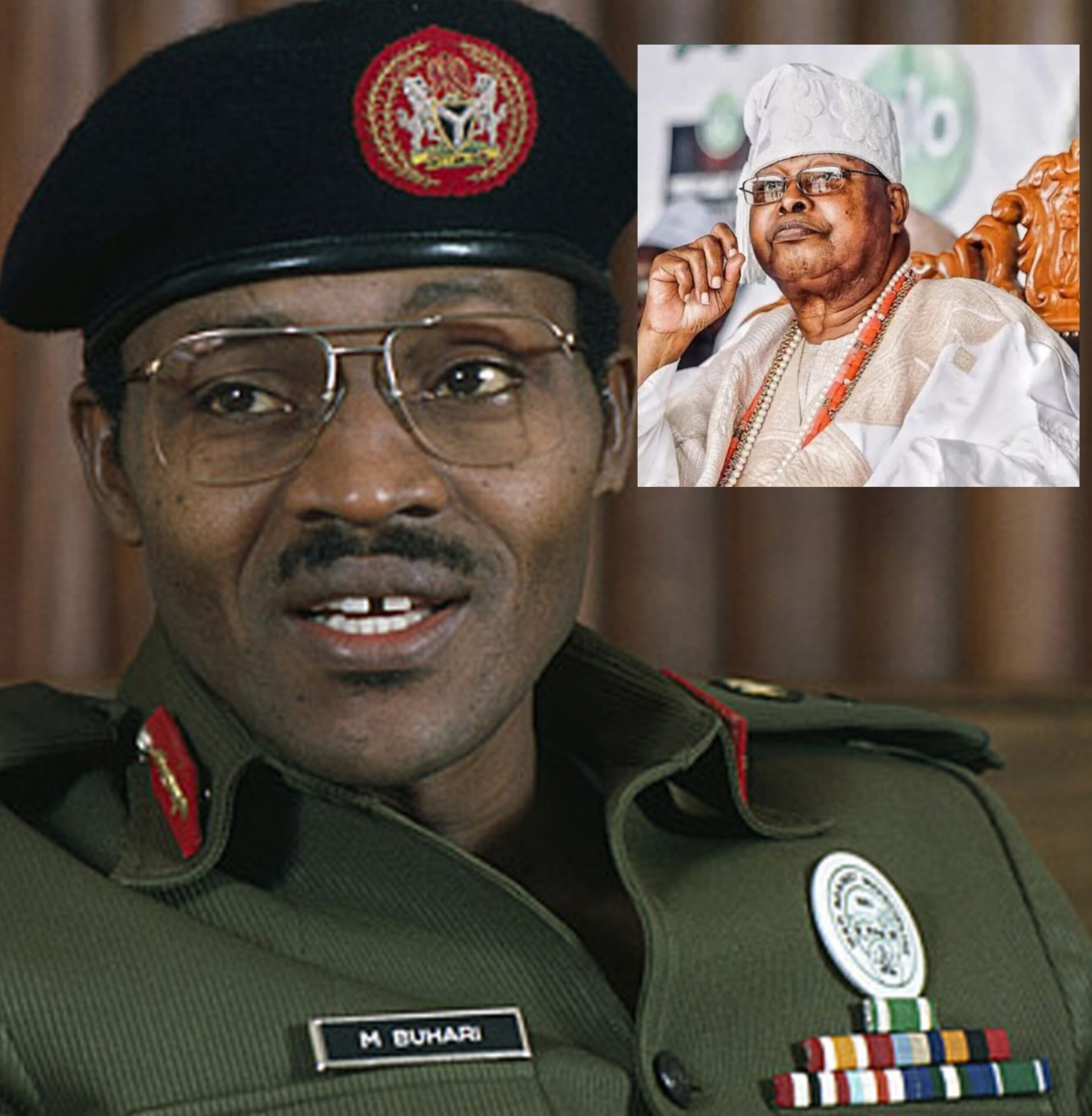
The King and The General
In the ancient palace of Ijebu Ode, where traditions run deeper than the roots of the mighty iroko, Oba Sikiru Kayode Adetona reigned as Awujale for more than six decades — a king renowned for his fearless tongue and unwavering integrity.
He was not the sort of monarch who bowed to power, whether military or civilian. He spoke truth as he saw it, challenged governors, and refused to be a puppet in anyone’s theatre of politics.
But even the most steadfast king can find himself in peril when the winds of power shift.
In late 1983, Nigeria’s Second Republic teetered on the edge of collapse. Corruption allegations swirled, politicians bickered, and the people groaned. In Ogun State, Governor Olabisi Onabanjo’s administration had grown weary of the outspoken Awujale.
They signed a formal order to depose him, scheduled to take effect on January 2, 1984. The tension in the palace was heavy. Courtiers whispered in fear. For all his defiance, Oba Adetona was about to lose his crown.
But history is full of strange mercies and unexpected twists.
On the night of December 31, 1983, while most of the nation slept unaware, soldiers moved quietly, their boots muffled against the earth. Major General Muhammadu Buhari led a bloodless coup that toppled the civilian government.
When dawn broke on January 1, 1984, the politicians were gone, the state assemblies dissolved — and with them, the legal foundation for the Awujale’s deposition.
Buhari didn’t launch the coup to save Adetona. He wasn’t thinking of any king in Ijebu. But in that act of overthrowing the civilian order, he wiped away the threat hanging over the Awujale’s head.
The order to remove him died stillborn. A monarch’s crown was saved, not by design, but by fate.
Oba Sikiru Adetona never forgot this. In later years, he acknowledged the timing with quiet gratitude. It was an extraordinary circumstance: a military coup, often feared for dethroning kings, had preserved his reign.
That event became the unlikely foundation of a lifelong bond.
A Quiet Bond
Their friendship did not grow in public spectacle. It was a quiet, enduring respect between two men of unbending character.
The Awujale was known for challenging any government that trampled on the people’s rights — even military rulers. They recognized in each other the rare trait of integrity.
Even during the turbulent Abacha years, their friendship held. While Buhari was involved in Abacha’s transition committee, the Awujale remained critical of the military’s refusal to restore democracy.
Yet they never let these differences break their bond. Instead, they maintained mutual respect.
By 2015, Buhari was no longer the young general who had led a coup but an older man. He journeyed to Ijebu Ode to visit the Awujale’s palace.
The king welcomed him not as a politician but as an old friend. He did not fawn or declare him a messiah. He gave him audience as an elder statesman — treating his campaign with respect while reminding him that the people’s choice was sacred.
Privately, the Awujale was said to admire Buhari’s discipline and simplicity — traits so scarce in Nigeria’s political class.
For Buhari, the Awujale was a traditional ruler who could not be bought, who spoke truth to power, and who kept his people’s interests above political games.
Their friendship was not based on patronage. Buhari never sought to use the Awujale for political endorsements in exchange for favors.
The Awujale never demanded appointments or contracts. Instead, they shared something rare: a trust rooted in shared values — and more things history couldn’t reveal to us. Maybe someday.
History’s Last Twist
And then, as if fate itself wanted to seal their story, they both left this world on the same day.
On 13th July 2025, just hours apart, Oba Sikiru Adetona, the Awujale of Ijebuland, and Muhammadu Buhari, the former military Head of State and civilian President, both drew their final breaths.
Source: HISTORY LOVERS