
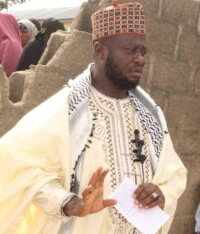
By Imam Murtadha Gusau
Sunday, August 03, 2025
In the Name of Allah, the Most Gracious, the Most Merciful
All praise is due to Allah. I testify that there is no deity worthy of worship except Allah and that Prophet Muhammad (Peace be upon him) is His servant and Messenger.
Dear brothers and sisters! The book, Al-Kawakib Al-Durriyah fi Madhu Khairil-bariyyah (The celestial lights in praise of the Best of Creation), is a famous poem written in honour of our beloved Prophet Muhammad (Peace be upon him). The poem is popularly known as Qasidah Al-Burdah (The poem of the mantle). It was composed by Sharaf Al-Din Muhammad Al-Busiri, a poet of Berber ancestry who lived in Egypt during the Mamluk era.
Al-Burdah (The mantle or cloak) is a reference to a miracle of Prophet Muhammad (Peace be upon him). Al-Busiri, who was paralysed by a stroke, claimed the Prophet Muhammad (Peace be upon him) appeared to him in a dream, and wrapped him in his mantle, curing him from paralysis. Composed in the powerfully lyrical basit meter, Al-Burdah comprises some 160 lines. Later poets added to the original or composed separate, parallel poems. Al-Burdah covers themes such as the necessity to control the caprices of the self, the Prophet’s choice to live in poverty, the suffering he endured, his Isra (ascension to heaven), and intercession through him on the Day of Judgment. The subject of more than 90 commentaries and translations into several languages, the poem endures because of its beauty and the lessons it conveys on spirituality, morality, history, and literary expression. Many lines from Al-Burdah adorn palaces and religious buildings, making it arguably the second most-used Arabic calligraphy text in Islamic architecture after the Qur’an. Cambridge University professor Timothy Winter considers the poem “very probably the most influential and the most popular single poem in the history of any language.”
Respected brothers and sisters! Chances are, you’ve heard portions of this growing up or in passing. It’s that famous “Maulaya Salli Wa Sallim” nashid so many know sing. The Qasidah Al-Burdah is a study of the sirah and spirituality all in one. It is a poem that contains many profound – even miraculous – secrets.
Today, over 800 years after it was composed, this ode to the Prophet Muhammad (Peace be upon him) is probably the world’s most often recited poem as well.
Reading, singing, and reciting the Qasidah Al-Burdah is a means for us to strengthen one’s love for the Prophet Muhammad (Peace be upon him) and connection to him. And connection to the Prophet Muhammad (Peace be upon him) is, of course, one of the best means of seeking the forgiveness, mercy, and pleasure of Allah, the Most High.
There are almost 2 billion Muslims worldwide. And it’s likely that almost all of them are familiar with the Qasidah Al-Burdah.
The Qasidah Al-Burdah is regularly sung in weekly, monthly, and annual gatherings across dozens of countries and a wide range of cultures. This tradition has continued for hundreds of years down to the present day. While, again, this is impossible to measure, it seems that the Qasidah Al-Burdah has gained a unique level of worldwide acceptance across language barriers and among different cultures.
This widespread appeal of the Qasidah Al-Burdah suggests that, in writing this poem, the author connected with something profound and universal.
The author of the Qasidah Al-Burdah, Al-Busiri’s full name was Abu Abdullah Sharaf Al-Din Muhammad Ibn Sa’id al-Busiri al-Sanhaji.
He was from the clan of Banu Habnum, a major branch of the North African Berber Sanhaji tribe.
It is reported that Al-Busiri was born in 608 AH (1211 CE) and died in 691 AH (1294 CE) at the age of 83 years.
Al-Busiri memorised the Qur’an at a young age, and moved to Cairo (Egypt) to pursue more advanced studies. It is said that he mastered a number of Islamic sciences, including Arabic language and grammar, linguistics, literature, Islamic history (Tarikh), Qur’anic exegesis (Tafsir), theology (Aqidah), logic, debate, and Prophetic biography (Sirah).
While Al-Busiri’s works are extremely famous, relatively little is known about the Imam himself.
It is said that among Al-Busiri’s students were Abu Al-Hayyan Al-Gharnati and Fath Al-Din Ibn Sayyid Al-Nas.
In the foreword to Mustafa Azzam’s singable translation of the Qasidah Al-Burdah, Abdul’aziz Suraqah writes that while in Cairo, Al-Busiri “earned his living writing calligraphy. He soon became famous in the region for his poetic prowess and lyrical skill, and was hired by some of Egypt’s government officials as a municipal clerk and court poet. His job was to write poetry in praise of the Sultan.”
A major transition in Al-Busiri’s life occurred when he became a student of Shaikh Abu Al-Abbas Al-Mursi, a teacher in the Shazili order. At that time, Imam Abu Al-Hasan Al-Shazili was still alive, and Al-Busiri wrote a famous eulogy for Imam Al-Shazili upon the latter’s death. Many of Al-Busiri’s contemporaries, who were also fellow students of Shaikh Abu Al-Abbas Al-Mursi, are famous to this day, including Ibn Ata’ullah Al-Iskandari and Shaikh Izzud-Din Ibn Abd Al-Salam.
It is said that another major catalyst for Al-Busiri’s spiritual growth was his Hajj, which he performed in 653 AH (1255 CE).
It is said that one of the secrets to the Qasidah Al-Burdah is that its author, Al-Busiri wrote the poem while in a state of complete brokenness and need, and utter humility before Allah.
Some of the commentators of Burdah explain:
“Al-Busiri was already a well-known poet and scholar when he composed the Qasidah Al-Burdah. Artists come to life when calamities call and Al-Busiri’s greatest poem was a result of a powerful tribulation when he awoke to find he was paralysed. Suddenly, this man – whose erudition and art had elevated him to the status of the prince of poets – was reduced to an invalid who was unable to rise from his bed. Within this state of affliction is the key to the Burdah’s legacy.”
Prior to this experience, Al-Busiri had been a famous poet in Cairo (Egypt), widely recognised by the rich and powerful of his society. He had received many accolades for his work. Yet he suddenly found himself in a situation where no one on earth, no matter how influential, could assist him in any way.
One version of the story, narrated with a full chain of transmission to Al-Busiri, is translated as follows:
“I had previously composed many poems in praise of the Messenger of Allah (Peace be upon him); among them some that Zainud-Din Ya’qub Ibn al-Zubair had suggested to me. It then transpired that I was stricken with hemiplegia, which left half of my body paralysed. At this moment, I thought of composing the poem [i.e. the Burdah], and so I did. With it, I asked for intercession with Allah and for Him to forgive me. I recited it over and over again; weeping, praying, and beseeching.” [See The Tale of the Burdah, page 12]
Al-Busiri continued in this state for some time. But one night, something miraculous occurred.
The commentators write:
“It is reported that Al-Busiri fell asleep whilst reciting couplet eight and that during this dream, he was honoured to recite the Qasidah Al-Burdah for the Prophet Muhammad (Peace be upon him).”
The Couplet eight is translated as follows:
“Yes! At night, visions of my beloved manifested, depriving me of sleep;
For love often disrupts delight with pain!” [See Qasidah Al-Burdah, chapter 1, verse 8]
Al-Busiri continued to recite the poem in his dream, with the Prophet Muhammad (Peace be upon him) as his audience. However, after reciting 50 verses, he reached a verse which was theretofore unfinished:
“The most we know of him (Peace be upon him) is that he (Peace be upon him) is a man, And [yet, without exception] he (Peace be upon him) is the best of Allah’s creation.” [See Qasidah Al-Burdah, chapter 3, verse 51]
After reciting the first half of the verse, Al-Busiri paused.
Then, miraculously, the Prophet Muhammad (Peace be upon him) himself completed the verse.
The commentators explain:
“On reaching couplet fifty-one, Al-Busiri recited the first hemistich and stopped as he had not finished the poem. Then, the most euphoric moment occurred: the Prophet Muhammad (Peace be upon him) completed the couplet with the second hemistich: ‘And [yet, without exception] he (Peace be upon him) is the best of Allah’s creation.’ Thus, showcasing the acceptance of the Burdah and its majesty.”
Due to its unique origin, the commentators note that this verse has a special status within the poem:
“Couplet fifty-one is to be recited thrice, during recitations, due to its significance.”
In one of the introductory essays of the Qasidah Al-Burdah, the commentators write:
“The Burdah is a literary rarity, casting readers into another realm. Each couplet is deeply rooted in Islamic history and tradition; symbolising Islam’s universal message of love, peace, and diversity by contextualising the importance of the Prophet Muhammad (Peace be upon him), whose mercy, compassion, kindness, and perfect character is the moral compass of all Muslims.”
Many people read the Burdah frequently, often as part of a daily routine of Zikr.
Some of the commentators and editors of the Qasidah Al-Burdah edition also put extensive efforts into the book’s design. Every detail of the edition is designed to help you read, study, and engage with this blessed poem. The original Arabic text is printed in beautifully ornamented, easy-to read script, arranged alongside a meticulously reviewed English translation. Some of the edition also includes over 100 footnotes, as well as extensive commentary drawing on dozens of traditional sources. The text is also printed on a high-grade paper, which has special properties designed to endure regular or daily reading over a long period of time.
In short, this is a book designed to be read frequently. And many, many people do read the Qasidah Al-Burdah frequently.
In the introduction to Ustaz Mustafa Azzam’s unique rhyming English translation of the Burdah, Abdul Aziz Suraqah writes:
“[The Burdah] is meant to be engaged with: to be experienced not only by the eyes that read it, but also by the voices that sing it and the ears that hear it. Celebrating the Prophet Muhammad (Peace be upon him) is not a spectator sport or a performance to be watched and appreciated from afar. It is an expression of love, or a conscious effort to open one’s self up to love and receive it.”
Like any literary masterpiece, the Burdah contains many layers of meaning that continue to reveal themselves with each reading. Among them are a number of unique prayers.
The commentators of the Qasidah Al-Burdah mention many unique benefits and blessings contained within specific verses of the poem. For example, couplet thirty-seven:
“To Allah was his (Peace be upon him) call; thus, whomever holds fast to him (Peace be upon him), Clings to a rope that will never break.” [See Chapter 3, verse 37]
The editors mention this couplet can strengthen the faith of the one who recites it.
Regarding the following verse, which refers to the Companions of the Prophet Muhammad (Peace be upon him):
“[The companions] were mountains, just ask those who accosted them, What it is they witnessed on the battlefield.” [See Chapter 8, verse 127]
Traditionally, this verse was known to be a sort of Du’a for protection of one’s home and property.
Another verse is considered to provide protection for travelers:
“Never did I suffer injustice when seeking his (Peace be upon him) protection, But that I was never oppressed, nor harmed.” [See Chapter 5, verse 80]
This verse is particularly recommended for those traveling on a long or potentially dangerous journey.
The commentators of the Qasidah Al-Burdah write the ninth chapter “can be considered the Burdah’s climactic point.”
Other verses specifically refer to one’s relationship to and loyalty to the Prophet Muhammad (Peace be upon him), and hope for his intercession:
“Yet, despite my sins, my pact remains unbroken, With the Prophet Muhammad (Peace be upon him), and my rope remains intact.” [See Chapter 9, verse 145]
Regarding this verse, the commentators write:
“Although accepting his shortcomings, the author is still optimistic; Islam is the religion of hope and Allah is as we perceive Him. Therefore, by maintaining the basis of faith, a person’s pledge with Allah and His Prophet (Peace be upon him) will always remain intact.”
In this spirit of hope, the Qasidah Al-Burdah concludes with this prayer for Allah’s forgiveness and bounty:
“Thus, this ode of the chosen one (Peace be upon him) has reached its finale, All praise is for Allah in its opening and conclusion, Its verses number one hundred and sixty, By them, alleviate us: O Master of Generosity! [O Allah] Pardon its singers and forgive its readers, We ask You for [all] goodness, o Possessor of Munificence.” [See Burdah, chapter 10, verses 8-10]
A passage from the essay “Virtues of the Burdah” provides a fitting conclusion to this piece:
“The Burdah is a poem of hope, inspiring generation after generation. By depicting and eulogising the great example of the Prophet Muhammad (Peace be upon him), the Burdah serves as a perfect model of redemption, purification, and enlightenment, which is epitomised by its thirty-sixth couplet: “He (Peace be upon him) is the beloved whose intercession is anticipated; A victor against every terror and calamity.”
For over 800 years, generation after generation has rediscovered the blessings and benefits of this extraordinary poem.
And in the introduction to his rhyming translation of the Qasidah Al-Burdah, Ustadh Mustafa Azzam writes:
“…the Burdah is a poem of hope. One of the many beautiful things about Al-Busiri’s Qasidah Al-Burdah is the broken state in which he presents it, making no claims to loftiness. Because the Burdah is not just for the saint and the scholar; the Burdah is for saint and sinner alike, for scholar and layman alike. It is a poem that allows every single one of us to say with our state: “Lord, my hope in You is not through my deeds; My hope in You is through the Chosen One. I come to You with grave sins on my back; But with Muhammad upon my tongue (Peace be upon him).” [See The Burdah: The Singable Translation of Busiri’s Classic Poem in Praise of the Prophet Muhammad (Peace be upon him)]
For further reading of what he calls “the journey of the Burdah,” see Ustaz Mustafa’s ongoing series of lectures on YouTube.
I hope this essay inspires you to reconnect with the Qasidah Al-Burdah, or to explore it for the first time.
Once again, the recitation of this poem is not meant to be a “spectator sport,” but a community activity!
The Qasidah Al-Burdah is indeed a central feature of community gatherings around the world. The poem is sung and recited in a vast range of cultures, and distinctive renditions of the Burdah have developed in many countries and regions, including: Nigeria, Niger, Ghana, Morocco, Syria, Egypt, Turkey, Somalia, Indonesia, Malaysia, Yemen, Senegal, Pakistan, Sri Lanka, Sudan, Saudi Arabia, Kenya, Bangladesh, Chechnya, India, UK, Europe, Japan, Spain, Canada, England, United States.
Dear brothers and sisters! The criticism of the Qasidah Al-Burdah is a relatively recent phenomenon. Over the 800 years since the poem was composed, hundreds of classical scholars have praised the poem and written commentaries on its meanings and merits. Criticism of the Burdah is quite rare by comparison, and nearly all arguments against the Burdah have been advanced within the past 50 years.
Finally, the Qasidah or ode Al-Burdah is regarded as one of the most famous poems in praise of the Prophet Muhammad (Peace be upon him), if not the most famous.
It was said that, as mentioned earlier, the reason for his composing it was that Al-Busiri was afflicted by a chronic disease, and no remedy was of any help; he used to send a great deal of blessings (Salawat) upon the Prophet Muhammad (Peace be upon him) until he saw the Prophet Muhammad (Peace be upon him) in a dream one night, and he covered him with his cloak (Burdah), and when Al-Busiri woke up, he stood up and there was no trace of sickness in him, so he composed this Qasidah. And Allah knows best whether this story is true or not.
Some of the scholars of Ahlus-Sunnah Wal-Jama‘ah have studied it and criticised it, pointing out its faults and the ways in which it is contrary to the beliefs of Ahlus-Sunnah Wal-Jama‘ah.
But sincerely speaking, the Qasidah Al-Burdah, a famous thirteenth-century Arabic poem in praise of Prophet Muhammad (Peace be upon him), has generally been well-received in the Ahlus-Sunnah wal-Jama’ah Muslim world, with many praising its beauty and spiritual impact. However, some verses in it have faced criticism for what is perceived as excessive praise or concepts that deviate from the orthodox Islamic belief.
Many Muslims view the Qasidah Al-Burdah as a powerful tool for strengthening love for the Prophet Muhammad (Peace be upon him) and fostering a deeper connection with him.
The poem is often recited to seek the Prophet’s intercession with Allah, which is considered a virtuous act in many Islamic traditions.
The poem’s widespread popularity and acceptance within the Ahlus-Sunnah wal-Jama’ah Muslim world suggest that it is generally seen as a positive and beneficial work.
Some believe that reciting the Qasidah Al-Burdah can bring blessings and protection from hardship.
Some verses in it are criticised for going beyond permissible limits in praising the Prophet, particularly those suggesting he had knowledge of the unseen or that he was a co-creator of the universe.
The critics argue that the poem’s language can be easily misinterpreted, leading to theological errors or exaggerations.
Some Islamic scholars caution against excessive reliance on intercession, emphasising that ultimately, all matters are in the hands of Allah.
While there isn’t a unified Salaf perspective, it’s generally accepted that the Salaf (early generations of Muslims) emphasised following the Prophet’s example and adhering to the core tenets of Islam.
Some Salafi scholars, known for their strict adherence to the Qur’an and Sunnah, express concerns about the Qasidah Al-Burdah, particularly regarding verses that might be seen as overstepping the bounds of permissible praise or promoting practices that deviate from orthodox belief.
Others, like those associated with the Minhajul-Qur’an International, view the poem as a valid expression of love for the Prophet Muhammad (Peace be upon him) and a source of spiritual benefit.
Respected brothers and sisters! Among the most prominent verses for which this poem has been criticised for having problem in Tauhid Ar-rububiyyah are the following:
“فإن مِن جودك الدنيا وضَرتها.”
“And of your generosity is the (creation) of the World and its co-wife (meaning the Hereafter)…”
They said here it is as if the World and the Hereafter was created from the generosity of the Prophet Muhammad (Peace be upon him).
And where they claimed the problem in Tauhid Asma wa sifat is the stanza:
“ومن علومك علم اللوح والقلم.”
“And part of your knowledge is the knowledge of the Tablet and the Pen…”
So PART of the knowledge of the Prophet Muhammad (Peace be upon him) is the knowledge that is encompassed in the Lauh al-Mahfuz – the tablet that has EVERYTHING written on it!! and that is only ‘part’ of his knowledge!!
Compare this poem with the authentic Hadith in Bukhari where a young girl said:
“And we have a Prophet who knows what will happen tomorrow.”
To which the Prophet Muhammad (Peace be upon him) said:
“Leave this (bit), and say the rest of it.”
They also said the problem in Tauhid uluhiyyah is in stanza:
“يا أكرمَ الخلْقِ مالي مَن ألوذُ به
سواك عند حدوثِ الحادثِ العَمم.”
“And who else there, besides you, who I can call out, at times of distress and problems?”
Here they asked how about our Creator, the only one the Prophet Muhammad (Peace be upon him) HIMSELF would turn to at times of distress??
These group of Islamic scholars said the poem is a prime example of over-praising the Prophet Muhammad (Peace be upon him) and putting him in a place where even he himself would not like.
While the Qasidah Al-Burdah is widely cherished for its spiritual and literary merit, some Islamic scholars and individuals have raised concerns about specific verses and their potential for misinterpretation or exaggeration. The overall view, however, is that it is generally considered a valuable poem within the Ahlus-Sunnah wal-Jama’ah Muslim tradition.
No doubt, there are some statements in the poem that contains some blunders and mistakes, by raising the status of the Prophet Muhammad (Peace be upon him) higher than it is supposed to be, but that doesn’t make it to be totally been condemned or rejected!
May you forever increase in love for Allah and His Messenger (Peace be upon him), ameen.
All praise is due to Allah, the Lord of the worlds. Prayers, peace and mercy are upon our beloved master, Muhammad, the son of Abdullah (Peace be upon him), his family and Companions.
Murtadha Muhammad Gusau is the Chief Imam of Nagazi-Uvete Jumu’ah and the late Alhaji Abdur-Rahman Okene’s Mosques, Okene, Kogi State, Nigeria. He can be reached via: gusauimam@gmail.com or +2348038289761.