
By Bilesanmi Abayomi
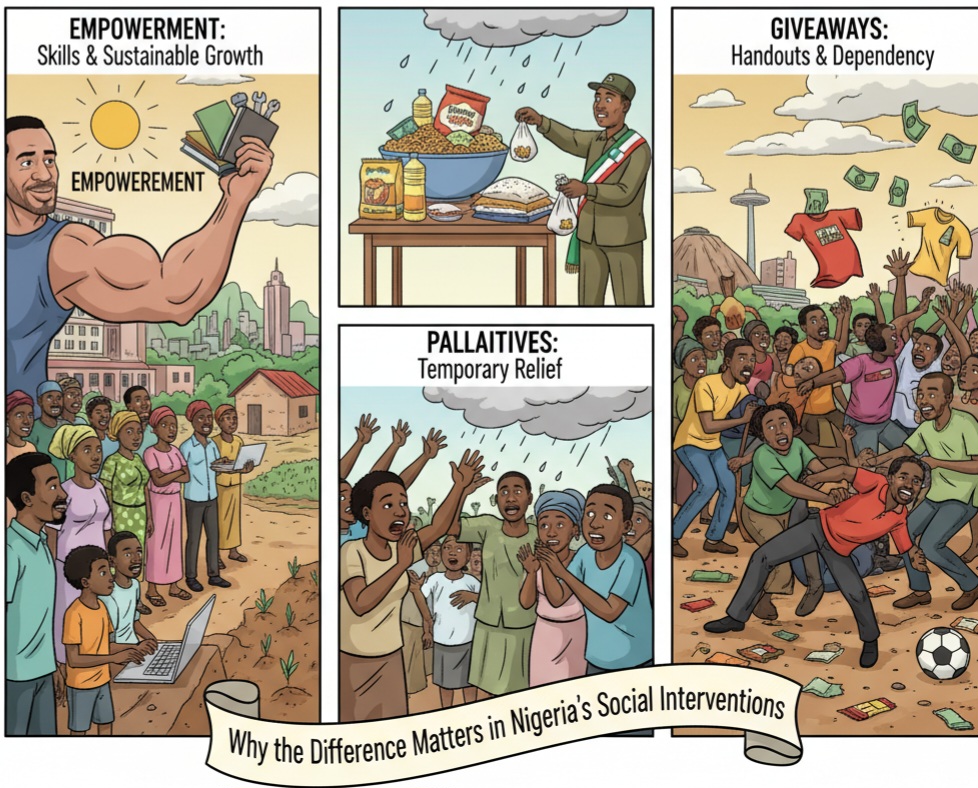
In recent years, governments, political leaders, corporate organizations, and philanthropists across Nigeria have rolled out numerous social intervention programmes aimed at improving livelihoods. However, terms such as empowerment, palliatives, and giveaways are often used interchangeably — blurring their distinct purposes and creating confusion among citizens and policymakers alike.
Yet, these three concepts differ fundamentally in intent, sustainability, and long-term impact.
Empowerment: Building Capacity for Independence
Empowerment is not a one-off gesture but a deliberate process of equipping individuals or groups with the skills, resources, or opportunities to become self-reliant. It involves capacity building, vocational training, business start-up support, agricultural inputs, or access to credit facilities.
For example, when a government provides sewing machines, grinding machines, or grants to small traders to expand their businesses, such an initiative qualifies as empowerment. Its goal is sustainability — helping beneficiaries generate income and, in turn, empower others.
Empowerment focuses on:
Capacity building
Economic independence
Skills acquisition
Long-term productivity
It answers the question: “How can we help people help themselves?”
Palliatives: Temporary Relief in Times of Hardship
Palliatives, unlike empowerment, are short-term interventions aimed at cushioning the effects of economic shocks, disasters, or emergencies. They offer immediate but temporary relief to affected populations.
Typical examples include the distribution of food items, cash transfers, or essential goods during crises such as the COVID-19 pandemic, floods, or the removal of fuel subsidies.
While palliatives are essential for maintaining social stability, they do not provide lasting solutions to poverty or unemployment. Once the items are consumed or funds depleted, beneficiaries often return to their prior economic state unless supported by empowerment programmes.
Palliatives focus on:
Immediate survival
Crisis management
Short-term welfare
It answers the question: “How can we help people survive right now?”
Giveaways: Acts of Kindness or Public Relations Tools
The term giveaway has gained popularity with the rise of social media, often used to describe spontaneous donations or gifts from individuals or organizations. These gestures, while generous, typically lack structure or measurable outcomes.
For instance, a celebrity transferring money to online followers, a politician sharing cash at public events, or a brand giving out phones in a promotional campaign are all examples of giveaways.
Giveaways create goodwill and excitement but rarely contribute to solving deeper socio-economic challenges.
Giveaways focus on:
Charity or generosity
Public relations
Short-term excitement
It answers the question: “How can we make people happy instantly?”
Why the Distinction Matters
Recognizing the difference between empowerment, palliatives, and giveaways is crucial for effective social policy. When empowerment is mistaken for palliative or giveaway, accountability diminishes, and sustainable development goals are undermined.
True empowerment transforms lives and communities; palliatives provide necessary but short-lived relief; giveaways generate momentary goodwill.
Experts therefore urge policymakers and community leaders to prioritise empowerment-driven programmes that promote job creation, entrepreneurship, and resilience — moving society from temporary relief to lasting opportunity.
Category Objective Duration Example
Empowerment Build capacity and self-reliance Long-term Skill training, start-up grants
Palliatives Provide relief during hardship Short-term Food distribution during crisis
Giveaways Express generosity or publicity Momentary Cash gifts, social media contests
Ultimately, true progress lies in shifting focus from giveaways and palliatives to empowerment — building a society where relief evolves into resilience, and handouts give way to opportunity.