
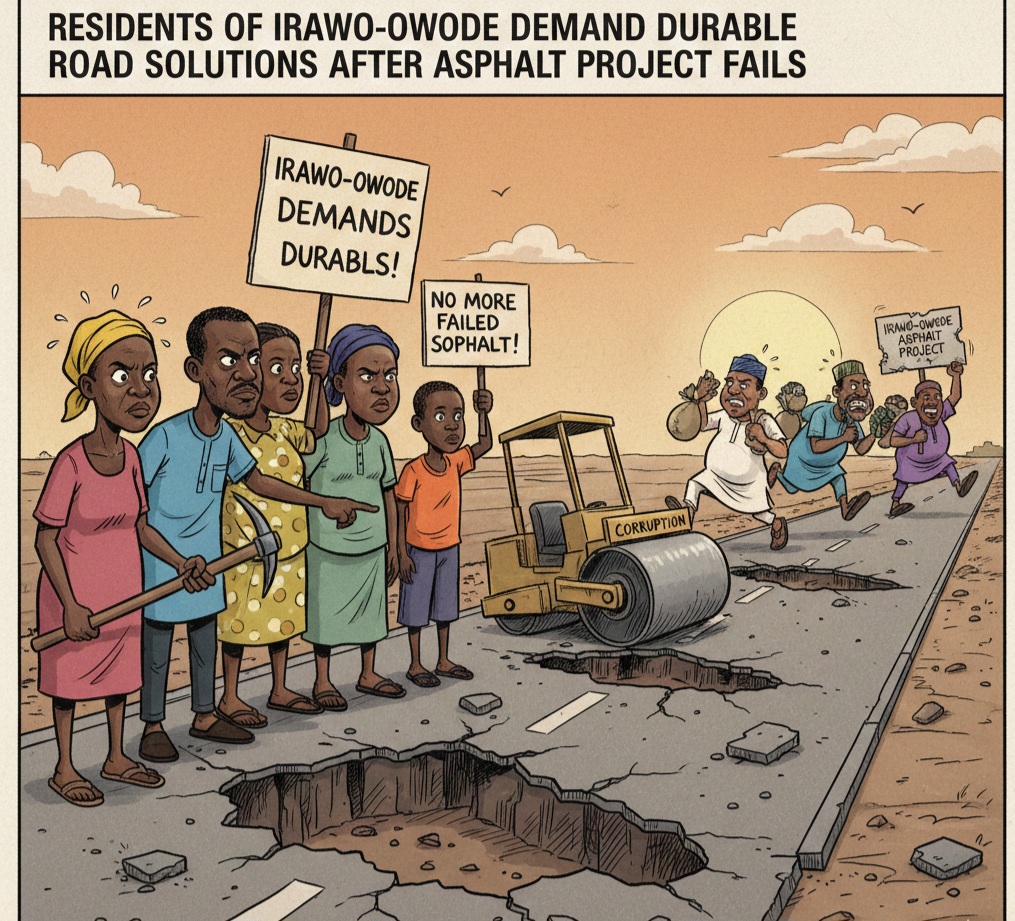
Residents of Irawo-Owode in Agboyi-Ketu LCDA, Kosofe, Lagos State, have urged government authorities and lawmakers to adopt interlock stones for road construction and rehabilitation following the rapid deterioration of a recently completed asphalt project on Ondo Street.
The road, part of a constituency project reportedly facilitated by Sen. Adetokunbo Abiru, was completed only about two weeks ago but has already failed, drawing public criticism. Initially lauded as a significant intervention in the community, the project quickly became a subject of outcry due to its substandard finish and lack of durability.
According to Hon. Okufuwa Samad Oluwatoyin, Lagos State Publicity Secretary of the Young Progressives Party (YPP):
“What they came to do on Ondo Street is what Yorubas call ‘Sagbe l’ojú yòyò’—a very shameful job. For an area with this topography, especially the Irawo–Ajegunle axis known for waterlogging, asphalt should never have been considered. Interlocking or concrete pavement is the right option.”
Samad accused the supervising agency of incompetence, alleging a waste of taxpayers’ money and poor enforcement of construction standards.
Community stakeholder Oloye Salami Oluwaseun added that supervising officials should be held accountable for allowing a substandard job, particularly under a federal government contractor, just weeks after project completion.
Public affairs analyst Omo’ba Awofeso Rasheed Ololade highlighted Lagos’ coastal terrain as unsuitable for asphalt, emphasizing that:
“By now, interlock stone should be the recommended option for road rehabilitation and construction in Lagos State. Asphalt is no longer popular because it lacks durability in recent times.”
Residents have shared images and videos documenting the poor state of the road, stressing the urgency for more durable alternatives to prevent further wastage of public funds and to ensure sustainable infrastructure in flood-prone areas.
The community is calling on state and federal authorities to prioritize interlock stones and concrete pavements for future projects, ensuring long-lasting improvements for residents of Irawo-Owode and other vulnerable communities.