
By Imam Murtadha Gusau
Tuesday, October 14, 2025
In the Name of Allah, The Entirely Merciful, the Especially Merciful
All praise be to Allah and peace be upon the Messenger of Allah. I bear witness that there is no god but Allah alone who has no partner and I bear witness that Muhammad is His Servant and Messenger.
Dear brothers and sisters! Indeed several Qur’anic verses prohibit despairing from Allah’s mercy, including Surah Az-Zumar (Qur’an, 39:53), which states:
“Say, [that Allah declares] ‘O My servants who have transgressed against themselves [through sin], do not despair of the mercy of Allah. Indeed, Allah forgives all sins. Indeed, it is He who is the Forgiving, the Merciful’.”
Other Qur’anic verses emphasise this prohibition by stating that despair is a characteristic of the astray or disbelieving people, such as in Surah Yusuf (Qur’an, 12:87), Allah the Most High says:
“Indeed, no one despairs of relief from Allah except the disbelieving people.”
And in Surah Al-Hijr (Qur’an, 15:56). Allah the Almighty says:
“And who despairs of the Mercy of his Lord except for those astray?”
Fellow brothers and sisters! Know that, no sin is too great for Allah to forgive, except for shirk, or associating partners with Him, if one dies upon it. For all other sins, sincere repentance, turning back to Allah, and seeking His mercy is the path to forgiveness. The Qur’an emphasises that Allah is “All-Forgiving, Most Merciful” and has promised to forgive all sins if a person turns back to Him in repentance before death.
Abu Sa‘id Al-Khudri (May Allah be pleased with him) reported: Prophet of Allah (Peace be upon him) said:
“There was a man from among a nation before you (from the children of Israel) who killed ninety-nine (99) people and then made an inquiry about the most learned person on the earth, and he was directed to a monk. He came to him and told him that he had killed ninety-nine (99) people and asked him if there was any chance for his repentance to be accepted? He said: “No”, and the man killed him also completing one hundred. He then asked about the most learned man in the earth. He was directed to a true Islamic scholar. He told him that he had killed one hundred people and asked him if there was any chance for his repentance to be accepted? He said: “Yes,” and asked: “Who stands between you and repentance? Go to such-and-such land; there [you will find] people devoted to prayer and worship of Allah, join them in worship, and do not come back to your land because it is an evil place.” So he went away and when he had reached half of the distance, death overtook him; and there was a dispute between the angels of mercy and the angels of torment. The angels of mercy pleaded: “This man has come with a repenting heart to Allah”, and the angels of punishment argued: “He never did a good deed in his life.” Then there appeared another angel in the form of a human being and the contending angels agreed to make him an arbiter between them. He said: “Measure the distance between the two lands. He will be considered belonging to the land to which he is nearer.” They measured and found him closer to the land (land of the pious people) where he intended to go, and so the angels of mercy collected his soul. In another version of the Ḥadith: “…He was found to be nearer to the locality of the pious by a cubit and was thus included among them.” Yet another version says: Allah commanded (the land which he wanted to leave) to move away and commanded the other land (his destination) to draw nearer and then He said: “Now measure the distance between them.” It was found that he was nearer to his goal by a hand’s span and was thus forgiven.”
Respected brothers and sisters! In this Prophetic Hadith of the man who killed ninety-nine (99) people is a powerful Islamic story of hope, demonstrating that sincere repentance can overcome even the greatest sins. It illustrates the importance of seeking knowledgeable counsel and emphasises that Allah’s mercy is available to all who turn to Him, even after a life of immense wrongdoing. A true Islamic scholar tells the man to leave his evil homeland for a new town to join people who worship Allah, but before he can arrive, death finds him, leading to a dispute between angels of mercy and wrath. The man is judged by the distance to the new land, and because he was closer to the pious town, the angels of mercy take him, showing that Allah’s grace extends to those who sincerely intend to change their ways.
Fellow Nigerians! Wallahi, as you all know, we are not pushing people to become criminals, but what we want people to understand is that, there is no sin too great to be pardoned by Allah as long as you repent sincerely before death, except for the sin of Shirk (associating partners with Him). The Qur’an encourages turning to Allah for forgiveness, emphasising that He is the All-Forgiving, Most Merciful. This hope should motivate repentance and renewal of faith, not despair.
In another Hadith, Abu Sa‘id Al-Khudri narrated that the Prophet Muhammad (Peace be upon him) mentioned a man from the people of the past, and told his story saying:
“Allah had given him wealth and children. When his death approached, he said to his sons: “What kind of father have I been to you?” They replied: “You have been a good father.” He told them that he had not presented any good deed before Allah, and if Allah should get hold of him He would punish him. “So look!” he added, “When I die, burn me, and when I turn into coal, crush me, and when there comes a windy day, scatter my ashes in the wind.” The Prophet added, “Then by Allah, he took a firm promise from his children to do so, and they did so, and threw his ashes on a windy day. Then Allah gave his command to his ashes, saying: “Be,” and behold! He became a man standing! Allah said: “O My servant! What made you do what you did?” He replied: “For fear of You,” and Nothing saved him then but Allah’s Mercy, so Allah forgave him.”
Dear brothers and sisters! This story is proof that we cannot enter paradise or be saved from the hell-fire purely on account of our deeds, we have to remember that ultimately it is from the mercy of Allah that we will be saved, this is in accordance with another Hadith of the Prophet Muhammad (Peace be upon him): Jabir reported: I heard Allah’s Messenger (Peace be upon him) as saying:
“None of you would get into Paradise because of his good deeds alone, and he would not be rescued from Fire, not even I, but because of the Mercy of Allah.” [Muslim]
Look, dear brothers and sisters! A wealthy man from the Banu Isra’il, fearing Allah’s punishment for a lifetime of sin, asked his children to burn his body after death and scatter his ashes on land and sea. Allah commanded the earth and sea to gather his ashes, brought him back to life, and asked why he did this. Upon his reply of “Fear of You,” Allah forgave him, demonstrating the immense mercy and power of Allah, and that despair over one’s sins is not a reason to give up on repentance.
To sum it up! No sin is too great for Allah to forgive, as long as one sincerely repents before death. Islam emphasises Allah’s boundless mercy and encourages turning to Him for forgiveness through sincere repentance, like saying Astaghfirullah (I seek Allah’s forgiveness). The Qur’an explicitly states that Allah “forgives all sins: for He is Oft-Forgiving, Most Merciful” and directs believers to “despair not of the Mercy of Allah.”
Allah Almighty does not grow tired of forgiving, so do not tire of seeking his forgiveness.
No sin is bigger than Allah’s mercy. When you turn towards Him with a heart full of guilt, He forgives.
Finally, dear brothers and sisters! President Bola Ahmed Tinubu is our leader. He can pardon on their behalf, discuss with them, and compensate them as the victims. And if they forgive the compensation is also good.
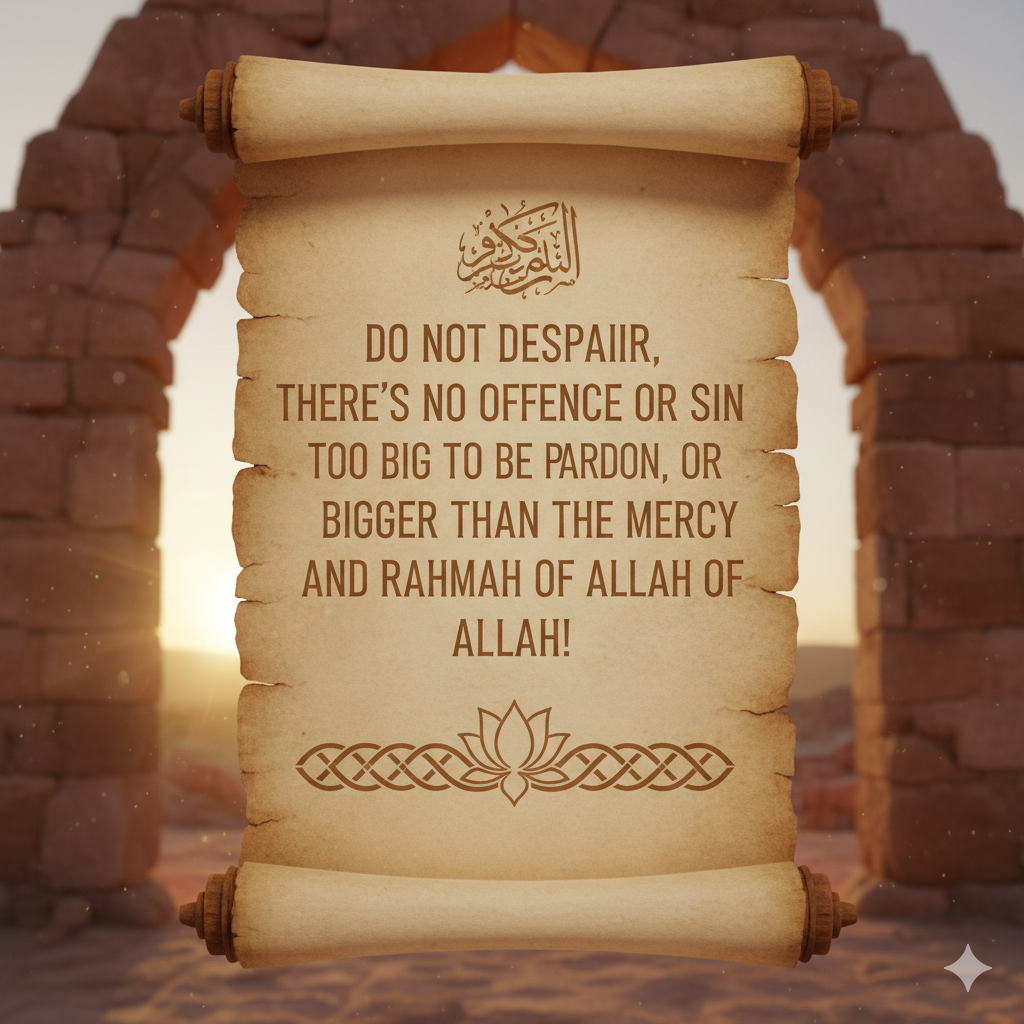
In Islam, there’s no offence or sin too big to be pardoned.
And the reason why we bicker and argue about Maryam Sanda’s case is because we are only looking at greatness of the offence, forgetting the vastness of Allah’s mercy and Rahmah.
If the Maslaha, unity and peace of our country, make it that she will be forgiving, then there’s no problem about it, especially if she repent, change and regret her action.
Yes, I cannot argue, in general rule of Islamic law, a leader cannot pardon the offender in crimes affecting an individual without seeking the consent of the victim or their heirs. For cases where an individual is directly affected, the victim has the right to decide whether to forgive the offender or demand punishment. However, a leader may pardon offenders in crimes where no individual is directly harmed, and the leader can also impose punishments for other crimes based on social and moral considerations.
In this Maryam Sanda’s case, someone told me the presidency is on discussion with victim’s family, if it’s true.
The leader’s role here is to facilitate this process but not override the victim’s decision.
When you think that someone sin is too much and unforgivable, know that, Allah’s blessings and mercy is even more than the sins he’ve committed. We will never get to paradise (Jannah) with our good deeds alone but through Allah’s mercy. Start again, try again, pray, cry, yearn. But don’t give up, don’t despair. May Allah forgive us all. Ameen.
Desperate Times Require Desperate Measures
The Arabic term “الضرورات تبيح المحظورات” translates to “necessity permits the prohibited” or “necessities make lawful what is forbidden.” It is an Islamic legal maxim, similar to the English saying “desperate times require desperate measures” or “necessity knows no law.” It means that in situations of extreme need or life-threatening emergencies, actions that are normally forbidden may be permitted to avert greater harm, provided the necessity is genuine and the action does not exceed the limits of the need.
The legal maxim is a principle in Islamic jurisprudence (Fiqh) that recognises that human safety and well-being are paramount. While certain actions are strictly prohibited in normal circumstances, the law can be temporarily suspended when an individual’s life is in danger.
An example cited in Islamic law is that it is forbidden to eat pork, but in a state of starvation where it is the only food available, a person may eat a small amount of it to survive.
This principle is applied to a wide range of situations, from personal emergencies, government policies to public health crises. The Covid-19 pandemic is cited as an example where this principle was used to allow for precautionary measures like lockdowns, which restrict normal freedoms.
The application of this legal maxim is not absolute. It requires that the need is genuine and the action taken is the minimum required to address the necessity. The prohibited action should only be a temporary solution to a serious problem and should not be an excessive response.
Wassalamu alaikum wa rahmatullah wa bara ka tuh
All praise is due to Allah, the Lord of the worlds. Prayers, peace and mercy are upon our beloved master, Muhammad, the son of Abdullah (Peace be upon him), his family and Companions.
Murtadha Muhammad Gusau is the Chief Imam of Nagazi-Uvete Jumu’ah and the late Alhaji Abdur-Rahman Okene’s Mosques, Okene, Kogi State, Nigeria. He can be reached via: gusauimam@gmail.com or +2348038289761 or +2348024192217.
Follow the KosofePost channel on WhatsApp:
https://whatsapp.com/channel/0029VaI0aMaLY6dAgcwppL3t