
By Bilesanmi Abayomi
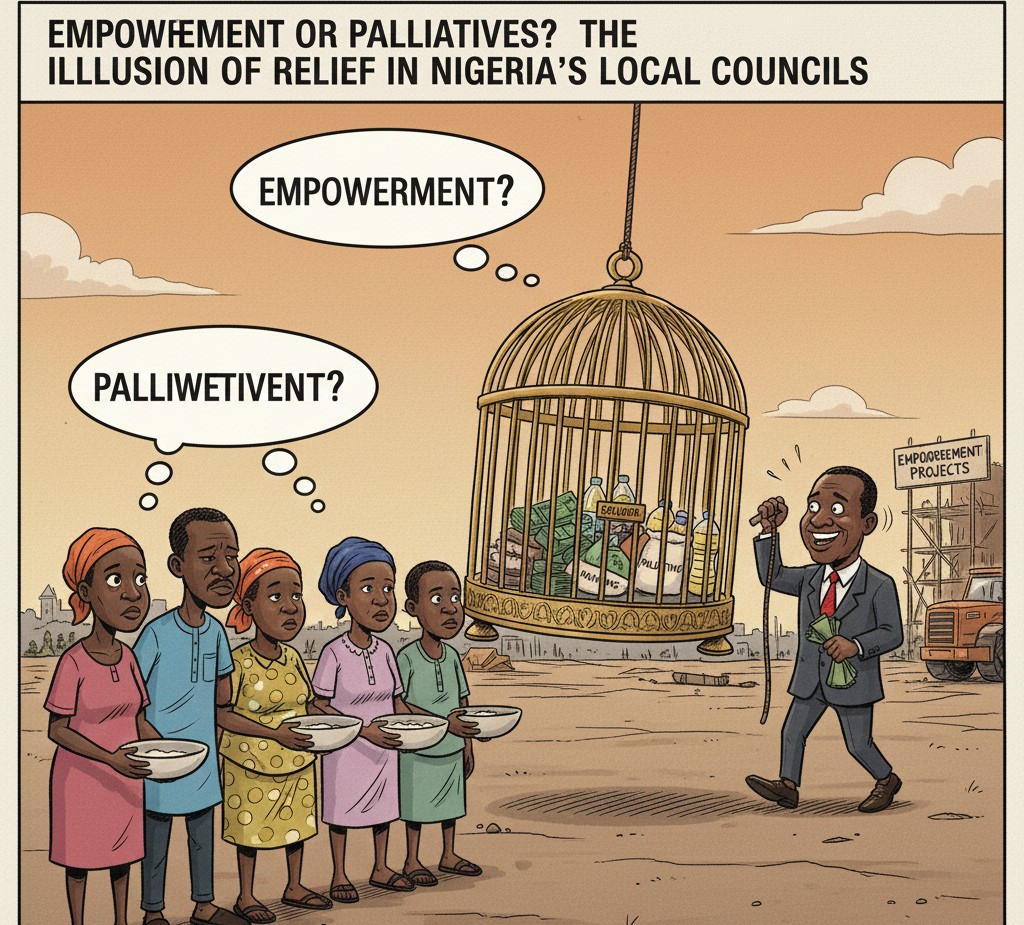
By all indications, economic hardship has become a permanent feature of life in Nigeria. In response, local councils across the country have rolled out what they often describe as empowerment programmes. However, when subjected to honest economic scrutiny, many of these initiatives amount to little more than cash handouts—palliatives dressed up with impressive titles and publicity.
Recent public debates and voice notes circulating in the public domain, some obtained by KosofePost, have further exposed the shallow nature of these so-called empowerment schemes. The pattern is familiar and troubling, and it demands reflection rather than applause.
A popular metaphor captures the situation clearly: a group of robbers escapes from a bank with sacks of stolen money. As the crowd shouts “thief!” and attempts to stop them, the robbers begin throwing bundles of cash into the air. Instantly, outrage gives way to excitement. The crowd abandons the chase and starts scrambling for money, chanting “Catch am! Catch am thief!” in the rhythm immortalised by Fela Anikulapo-Kuti. The robbers, having successfully distracted their pursuers, escape without consequence.
This analogy closely mirrors developments in some local governments. Individuals close to council chairmen reportedly nominate multiple beneficiaries for empowerment programmes, only to later collect between 50 and 80 per cent of the funds disbursed. What is publicly presented as empowerment thus becomes a transactional arrangement, with public funds recycled among political loyalists and intermediaries.
Such practices expose an uncomfortable truth: many of these initiatives were never designed to deliver meaningful empowerment. Instead, they function largely as tools for political validation—aimed at securing praise, loyalty, and public approval for their sponsors. Able-bodied citizens receive token sums, while the deeper issues of poverty, unemployment, poor infrastructure, and weak social services remain unaddressed.
The irony is striking. Many local government chairmen reportedly maintain second homes in countries such as the United Kingdom, Canada, and the United States. On their visits abroad, they might consider observing how social welfare systems and food banks operate in those societies—frameworks built on dignity, transparency, and fairness, largely free from political patronage and middleman exploitation.
True empowerment is not measured by the number of envelopes shared at public ceremonies. It is measured by sustainable policies, skills development, job creation, and accountable governance. Until local councils move beyond performative generosity and embrace genuine social investment, Nigerians will remain distracted by falling banknotes while the real culprits quietly disappear into the distance.