
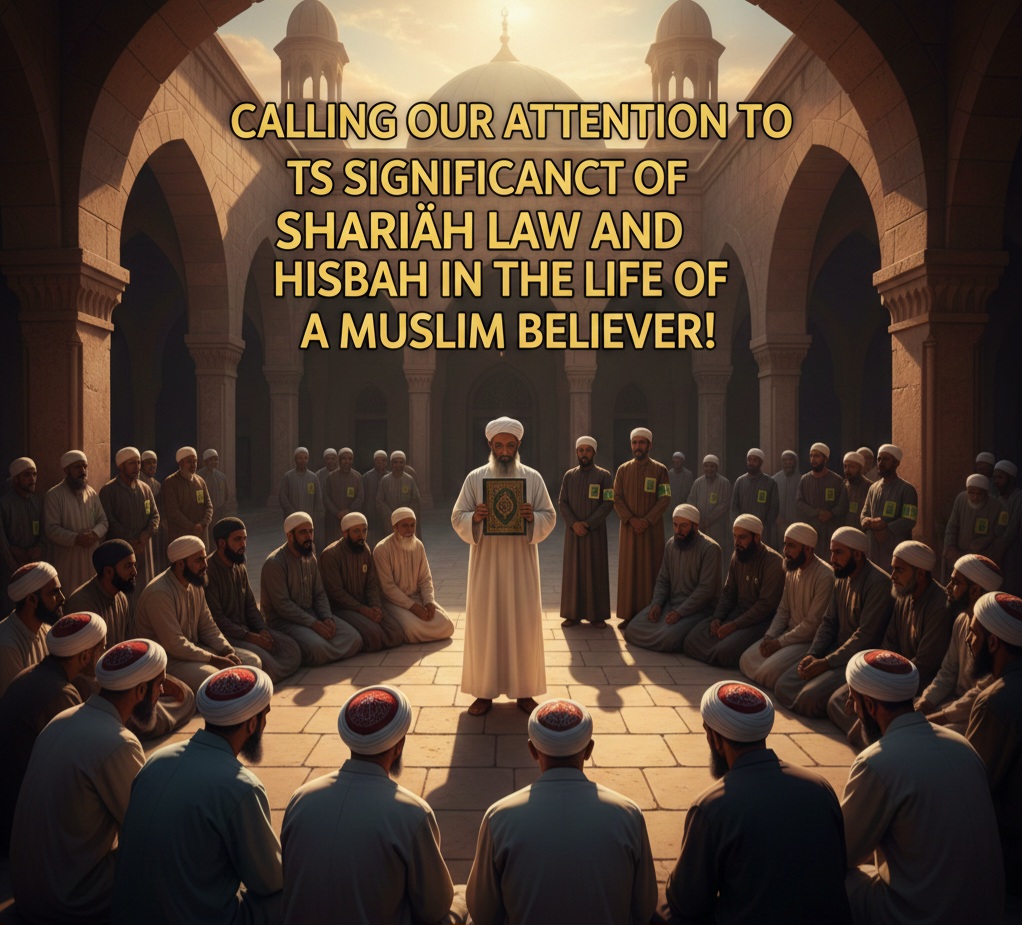
By Imam Murtadha Gusau
Monday, December 08, 2025
In the Name of Allah, the Most Gracious, the Most Merciful
Praise is due to Allah, Lord of the worlds, may the blessings and peace be upon our beloved master Muhammad, the last of Prophets, on his family, and all his companions.
Dear brothers and sisters! Know that, Shari’ah law is very important to Muslim believers as it provides divine guidance for all aspects of their lives, from spiritual and religious practices to social, economic, and political matters. It is viewed as a path to fulfill the purpose of serving Allah Almighty, fostering justice, promoting moral values, and achieving success in this life and the hereafter. Shari’ah law acts as a comprehensive framework for daily conduct, covering personal behaviour, family life, and financial transactions.
Shari’ah law governs acts of worship, such as prayer, fasting, and pilgrimage, and includes the core beliefs of Islam.
It provides guidelines for personal conduct, encouraging qualities like forgiveness, courtesy, and respect for others.
It includes principles for marriage, divorce, and inheritance.
Shari’ah law provides a framework for business and financial transactions, emphasising ethical practices and prohibiting specific activities like interest-based lending (riba).
Muslim believers believe that following Shari’ah law is a way to be a complete servant to Allah Almighty and to achieve success in this life and the hereafter.
Shari’ah law aims to create a just and balanced society by providing a legal and ethical system that is devoid of injustice and selfish interests.
Shari’ah law is a comprehensive system, with guidance on virtually every facet of human life, from the mundane to the spiritual.
It establishes boundaries for behaviour, classifying actions into categories such as obligatory, recommended, permitted, discouraged, and forbidden.
Respected brothers and sisters! Shari’ah law in its general sense means the way, and thus the Islamic Shari’ah is the way revealed to our beloved Prophet Muhammad (Peace be upon him). Allah Almighty says:
“Then We put you on the (right) Way [Shari’ah] of Religion: so follow that (Way).” [Qur’an, 45:18]
This revealed text has been understood and interpreted through the application of Prophet Muhammad (Peace be upon him) as well as the Ijtihad of Muslims through centuries. Shari’ah law in its more specific sense means legislation, Allah Almighty says:
“To each among you have we prescribed a law [Shir’ah] and a method.” [Qur’an, 5:48]
The Islamic legislation constitutes meanings, laws, rules and principles concerning human actions. Particularly, it aims at identifying the legal rulings for the actions of the legally competent persons.
Shari’ah law means the divine path in Islam. It comes from Allah’s guidance in the Qur’an and the teachings and example of Prophet Muhammad (Peace be upon him). Shari’ah law gives rules for worship, ethics, family life, commerce, and more. It demands justice, compassion, and protection of faith, life, intellect, lineage, and property—known as the Maqasid al‑Shari’ah.
Shari’ah remains fixed as divine law. Islamic scholars interpret it through fiqh, which means jurisprudence or legal reasoning. So while Shari’ah law is perfect and unchanging, fiqh adapts to changing times and needs.
Muslims received the Qur’an between 610 CE and 632 CE. Prophet Muhammad (Peace be upon him), both spiritual and temporal leader, guided the early Muslim community in implementing divine rulings after his passing in 632 CE, his companions and successors governed using principles in the Qur’an and Sunnah.
By the 8th and 9th centuries, Islamic scholars developed Usulul‑Fiqh, principles of legal methodology. They began to form schools of jurisprudence: Hanafi, Maliki, Shafi‘i, and Hanbali in Sunni Islam, and Ja‘afari in Shi’a Islam. These schools shaped how communities practiced Shari’ah law in different cultures and societies.
By the 10th century, legal reasoning solidified. Islamic scholars built authoritative legal doctrines in each mazhab to advise leaders and guide judges. Traditions governed marriages, inheritance, worship, contracts, and public order, even penal codes, yet always emphasised fairness and mercy.
Shari’ah law originated from two main sources: The Qur’an, Allah’s final revelation, providing core values and principles. The Sunnah, authentic Hadiths and the Prophet’s practices. Islamic scholars also use tools like ijmaʿ (consensus) and qiyas (analogy) when direct rulings don’t exist. These tools ensure fairness and wisdom in new circumstances while maintaining divine guidance. This rooted yet flexible approach keeps Shari’ah law relevant and transformative.
When you study fiqh, you learn how to apply Shari’ah law to modern choices—ritual, commerce, family, governance. Fiqh works to clarify, explain, and guide every action. Islamic scholars trained for years to interpret rulings, and they use rigorous methods to ensure accuracy and compassion.
Deepening fiqh knowledge brings confidence. This confidence helps you worship better, conduct ethical business, and live family life with Islamic values.
Rituals of worship are the heart of a Muslim’s life. These acts connect Muslim believers with their Creator, Allah Almighty, and build discipline, gratitude, and unity.
Shari’ah law defines every aspect of worship—from intention to actions—based on authentic sources. Fiqh guides how these rules apply based on ability, time, and place.
The five pillars of Islam are central to Shariah’s worship rulings: Shahada – the testimony of faith
Salah (Prayer) – performed five times daily, with rules on cleanliness, timing, direction, and recitation. Zakat (Charity) – a fixed share of wealth for the needy. Sawm (Fasting in Ramadan) – refraining from food, drink, and harmful behaviour from dawn till sunset. Hajj (Pilgrimage to Makkah) – a once-in-a-lifetime journey, if one has the means.
Shari’ah law provides clarity so Muslims know exactly how to fulfill these duties with sincerity and precision. Through worship, Shari’ah law instills self-purification, community support, and spiritual strength.
Shari’ah law is not just about personal piety—it’s about building a just, caring society. It addresses family life, economics, governance, politics, health, education, and public behaviour.
Shari’ah law gives strong rights to spouses, children, and parents. It organises inheritance, divorce, guardianship, and maintenance with justice and mercy.
It bans interest (riba) and promotes honest trade. Business ethics, fair contracts, and zakat to ensure economic balance.
Shari’ah law encourages truthfulness, cleanliness, helping neighbours, and social justice. It also outlines laws on crime, punishment, and public responsibility—but always within the limits of compassion, evidence, and due process.
While there’s no fixed “Islamic state model,” Shari’ah law supports governance based on consultation (shura), justice, and accountability. A leader should protect rights, serve people, and uphold the public good.
Understanding Shari’ah law and implementing it brings powerful changes in the life of a Muslim: It helps you support others—making your family and community thrive. It strengthens your faith with clarity and purpose. It builds integrity in daily choices. It fosters fairness in both personal and social life. It fills your heart with hope and mercy, knowing divine guidance leads you.
Some people misunderstand Shari’ah law, especially some Americans and other non-Muslims, because they see legal extremes or political regimes. Real Shari’ah law emphasises mercy and ethics. It does not force, only invites. It balances limits with grace and applies only within fair guidelines. Many misrepresentations come from politics, not fiqh or theology.
For Muslim believers, If you want to understand Shari’ah law begin by reading the Qur’an with commentary and learning authentic Hadith. Study fiqh within a supportive community. Seek reputable scholars. Join structured programs that help you apply Shari’ah law compassionately and confidently.
Fellow brothers and sisters! Know that, Shari’ah law does not change—Qur’an and Sunnah remain fixed. Fiqh rulings adapt to new contexts through rigorous scholarship and proper methods.
And Shari’ah law is not about punishment only. It also focuses on balance, compassion, and guidance. Punishments exist but apply under strict criteria. Mercy and prevention matter most.
In many communities, Muslim believers follow Shari’ah law privately while living in legal systems where non‑Muslims also enjoy justice and rights.
Fiqh enables clarity in worship, business, family, and moral choices. It shapes decisions aligned with divine guidance.
Shari’ah law grants women rights in inheritance, education, marriage consent, and economic activity. Real-world misconceptions often misrepresent these rights.
Shari’ah law forms the beautiful bond between Muslim believers and their faith. It uplifts individuals and communities through justice, worship, and ethics. Studying Shari’ah law through Qur’an, Sunnah, and fiqh deepens your spirituality and purpose. Feel hopeful, empowered, and inspired to live life under divine guidance.
Dear brothers and sisters! Shari’ah law is crucial for Muslim believers because it provides a divinely-guided correct path for all aspects of their lives, from personal worship and ethics to social, economic, and political matters. It is derived from the Qur’an and the Sunnah and aims to guide Muslim believers toward fulfilling their purpose of servitude to Allah, ensuring success in this life and the hereafter.
And Hisbah in Islam is a powerful, foundational principle rooted in the Qur’anic command of “enjoining what is right and forbidding what is wrong” (al-amru bil-ma’ruf wal-nahyi anil munkar), serving as a mechanism for social accountability, justice, and the overall well-being of the community.
Hisbah is a collective duty (fard kifaya) upon the Muslim community, giving every individual an active role in society. It transforms passive citizenry into a self-correcting force, ensuring the government and society remain on a righteous path. The Qur’an reminds Muslim believers that they are the best of nations precisely because they uphold this duty. When Hisbah is taken seriously, communities can curb malpractices, fraud, and injustice, fostering a highly moral society.
The Prophet Muhammad (Peace be upon him) himself was the first Muhtasib (official of Hisbah), personally conducting market inspections to ensure fairness. In a famous incident, he found a seller who had hidden wet wheat under dry, leading him to declare:
“Whoever cheats is not one of us.” [Muslims]
This powerful example teaches us that Hisbah is not just about major sins, but also about honesty, integrity, and preventing exploitation in daily interactions, ensuring economic stability and social trust.
Also the Rightly Guided Caliphs continued and institutionalised this legacy.
For example, Umar (RA) formally established the office of the Muhtasib (official of Hisbah), whose duties included market supervision, maintaining public order, and ensuring proper performance of religious obligations. His use of a simple stick (Dirrah) for petty wrongs, which he applied without discrimination, struck immense fear of injustice in people’s hearts.
Abubakar (RA), in his inaugural address, set the precedent for accountability, stating that:
“Obey me as long as I obey Allah and His Messenger. If I disobey them, then you have no obligation to obey me.”
This demonstrates the intrinsic link between leadership, adherence to divine law, and public accountability.
Ultimately, Hisbah is an act of Ibadah (worship). To be effective, it must be performed with sincerity, knowledge, leniency, mercy, patience, and the objective of protecting the community’s well-being. It is not about harsh judgment of private beliefs (which are for Allah alone to judge on the Day of Reckoning) but about addressing obvious, public wrongs for the sake of Allah, not for material or worldly benefits. The profound internal motivational force comes from the belief in ultimate accountability to Allah Almighty on the Day of Judgment, when every soul will see the weight of their deeds, no matter how small.
Respected brothers and sisters! Shari’ah-oriented political scientists define Hisbah as the duty of enjoining good when it is neglected and forbidding evil when it is prevalent in society.
Ibn Khaldun considers Hisbah as a religious post. That is why Muslim jurists (Fuqaha) differentiate between the Muhtasib (one who practices Hisbah), who is appointed by the head of state or governor to look after the state’s subjects, and the Mutatawi’i (volunteer), who practices Hisbah without being assigned by the political authority.
Historically, Hisbah as a system was founded in the political life of Muslims during the era of Caliph Umar Ibn Al-Khattab. However, the term itself was known only in the era of the Abbasid caliph Al-Mahdi. According to Sheikh Yusuf Al-Qaradawi, Hisbah started in a simple form in the early days of Islam, but acquired various features and ramifications over time. In fact, some contemporary government ministries and departments — such as those of health, social affairs, municipalities, transport, and police — are now assuming duties that used to be entrusted to the Muhtasib (official of Hisbah). The Muhtasib must be a capable, discerning Muslim adult. This person serves as the eye of the law on both state and society.
Hisbah, as defined earlier, is the duty of promoting what is good and preventing what is evil. It is a collective duty or obligation of the Muslim Ummah. Hence, a considerable number of individuals should assume this responsibility, take an affirmative stand toward it, and put it into practice whenever there is a need for it.
Hisbah is a broad Qur’anic principle that encompasses both the government’s responsibilities as well as any effort exerted by the individual to resolve a conflict or misunderstanding between two individuals, groups, friends, families, or strangers. Hisbah thus encourages the individual to participate and get involved in society as an active agent who is mindful of the problems and concerns of the community where he or she lives.
There are several verses in the Ever-Glorious Qur’an on Hisbah, which is also one of the major themes of the Prophetic Sunnah. Muslim jurists (Fuqaha) have also spoken at length on the conditions and valid application of Hisbah, which need not be reviewed here. However, one deems it mandatory to mention that Ibn Taymiyah specified certain conditions for one to be eligible to be a Muhtasib (official of Hisbah) such as knowledge, leniency, mercy and patience.
The Pillars of Hisbah:
- The Muhtasib (official of Hisbah), who must be a capable, discerning Muslim adult. This person serves as the eye of the law on both state and society. In other words, this person supervises the application of the law in society, especially in the marketplace, to protect it against treachery, mishandling, monopoly, usury, exaggerated profits, and the like.
- A flagrant evil that exists. It should be so clear to the Muhtasib, in such a way that requires no effort exerted for noticing it.
- The process of Hisbah itself, which refers to the regulation or censorship of public morals as described above.
May Allah bless our journey with peace, mercy, knowledge, understanding and heart‑filling hope, ameen.
All praise is due to Allah, the Lord of the worlds. Prayers, peace and mercy are upon our beloved master, Muhammad, the son of Abdullah (Peace be upon him), his family and Companions.
Murtadha Muhammad Gusau is the Chief Imam of Nagazi-Uvete Jumu’ah and the late Alhaji Abdur-Rahman Okene’s Mosques, Okene, Kogi State, Nigeria. He can be reached via: gusauimam@gmail.com or +2348038289761 or +2348024192217.