
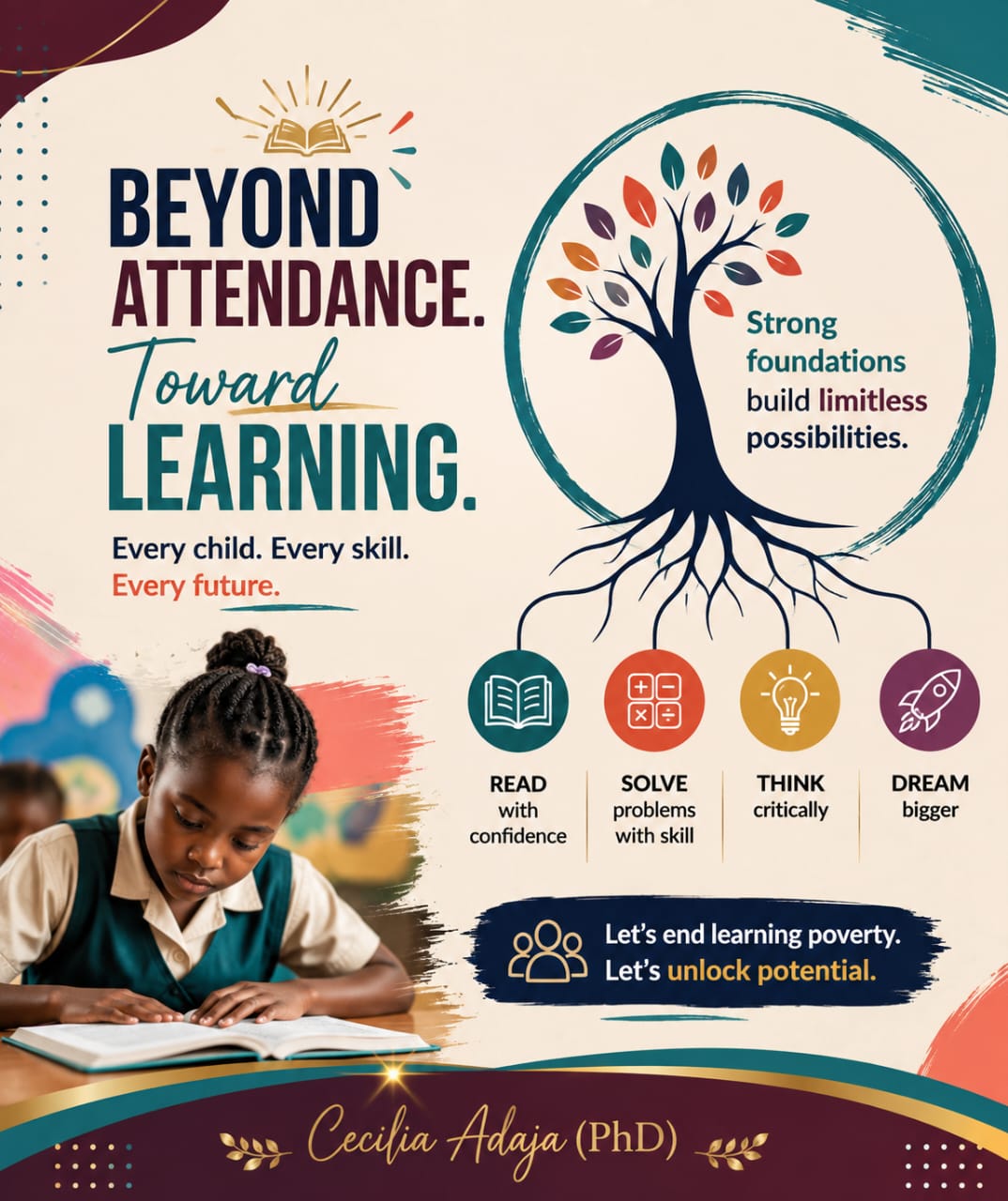
Millions of children go to school every day. They wear uniforms, carry school bags, greet their teachers, and sit through lessons.
Yet many of them are not truly learning.
This is the reality of learning poverty.
Learning poverty refers to the inability of a child to read and understand a simple age-appropriate text by the age of 10. It is one of the clearest indicators that an education system is struggling to deliver on its most fundamental promise.
For many people, the conversation around education begins with school enrolment.
– How many children are in school?
– How many classrooms have been built?
– How many teachers have been recruited?
These are important questions.
But they are not enough.
Because being in school is not the same as learning.
A child who spends six years in primary school yet cannot read fluently has been present in the classroom but absent from meaningful learning.
That should concern every one of us.
Learning poverty is not simply a statistic in a report. It has a human face.
It is the girl who quietly memorises answers because she cannot read the questions.
It is the boy who gradually loses confidence because every lesson feels like a language he cannot understand.
It is the teacher working with overcrowded classrooms and limited resources, trying to help every learner move forward.
It is the parent who believes education will change the future of their child, only to discover years later that school attendance did not translate into learning.
The effects do not end in primary school.
Children who fail to master foundational literacy and numeracy often struggle throughout secondary school, find it harder to access higher education, and face reduced employment opportunities as adults.
The gap widens with every passing year.
This is why foundational learning deserves far greater attention.
When children develop strong reading, writing, and numeracy skills early, every other subject becomes more accessible.
Science makes sense.
Mathematics becomes less intimidating.
History becomes a story rather than a collection of unfamiliar words.
Technology becomes a tool for exploration instead of another barrier.
Strong foundations create lifelong learners.
Weak foundations create lifelong disadvantages.
Addressing learning poverty requires more than good intentions.
It calls for evidence-informed policies, regular learning assessments, well-supported teachers, access to quality learning materials, mother-tongue instruction where appropriate, and education data that helps identify struggling learners before they fall too far behind.
Governments have an important role.
Schools have an important role.
Teachers have an important role.
Parents have an important role.
Researchers have an important role.
Every organisation committed to improving education has an important role.
Advocacy matters because problems that remain invisible rarely receive the urgency they deserve.
Every conversation about learning poverty raises awareness.
Every piece of research strengthens the evidence base.
Every intervention that helps one child read confidently changes the trajectory of a life.
The goal is not simply to increase the number of children sitting in classrooms.
The goal is to ensure that every child leaves the classroom with the knowledge, skills, and confidence needed to thrive.
Because the true measure of an education system is not how many children attend school.
It is how many children actually learn.
Cecilia Adaja (PhD)