
By Bilesanmi Abayomi
While some public officials frequently cite inadequate remuneration as a constraint on their ability to serve their constituents, Councillor Kazeem Oluwaseun Balogun, representing Ward B in Agboyi-Ketu LCDA of Kosofe, is taking a different approach by funding community interventions from his personal resources.
Balogun, who assumed office about a year ago, has continued a pattern of grassroots philanthropy that predates his election, supporting residents through humanitarian initiatives and community projects.
Rather than using the relatively low remuneration of local government legislators as an excuse for limited engagement, the councillor said his personal commitment to the people would not allow him to ignore their needs.
“I can’t look away.”
Free Medical and Social Services
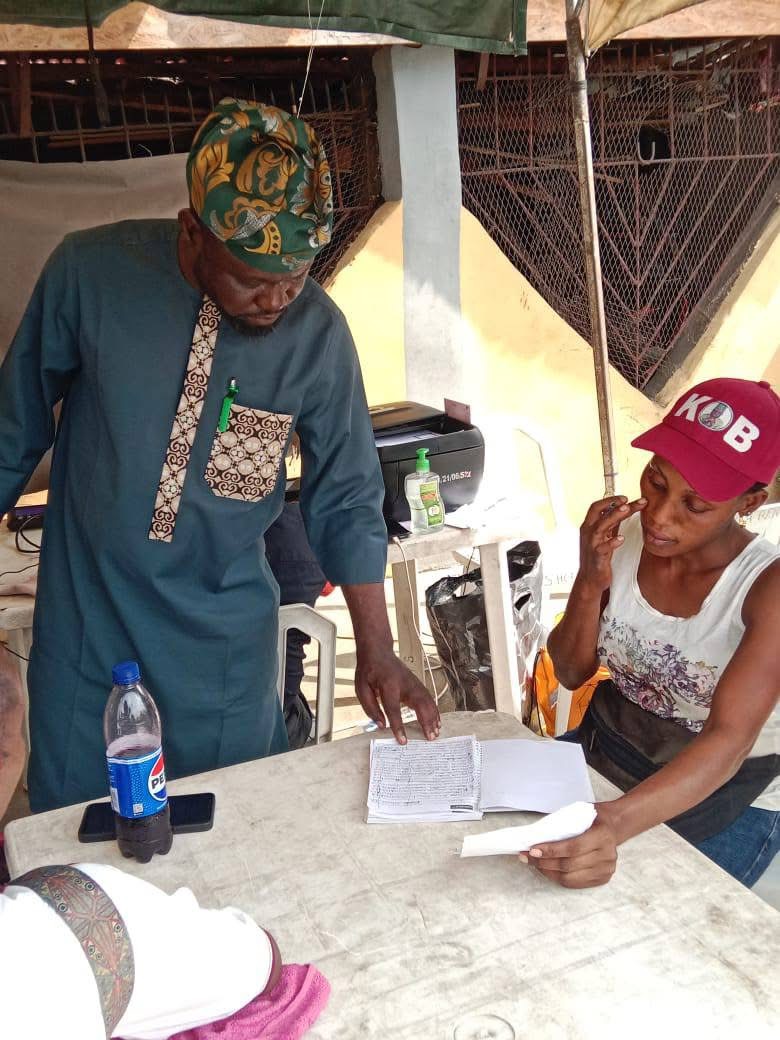
Through the Kazeem Oluwaseun Balogun (KOB) Foundation, in partnership with the Eye Foundation, Balogun organised a free medical outreach on Saturday, bringing healthcare and documentation services directly to residents.
The intervention included: Free eye screenings and distribution of prescribed eye drops; Cataract surgeries for residents requiring vision-restoring treatment; Free reading glasses for people with impaired vision; National Identification Number (NIN) registration; and Lagos State Residents Registration Agency (LASRRA) registration.
The initiative was designed to address both immediate healthcare needs and administrative barriers that prevent residents from accessing essential government services.
From Healthcare to Infrastructure
The latest intervention builds on other community projects undertaken by the councillor since assuming office, including installing a community borehole to improve access to water within the ward.
For Balogun, the interventions represent an extension of his approach to public service beyond formal legislative responsibilities.
A Different Standard for Grassroots Representation
Balogun’s activities are also challenging a familiar argument in local politics: that limited remuneration makes it difficult for elected representatives to meaningfully support their constituents.
While personal philanthropy cannot replace the responsibility of government to provide public services, his approach demonstrates that elected representatives can still identify urgent needs, mobilise resources and maintain direct contact with the communities they represent.
The bigger lesson, however, is not that public officials should personally finance government responsibilities. Rather, it is that constituency representation should be measured by responsiveness, accountability and tangible engagement—not simply by the size of an official’s salary or the resources attached to their office.