
By Imam Murtadha Gusau
In the Name of Allah, the Most Gracious, the Most Merciful
Praise be to Allah, Who established the First House for humanity at Bakkah—a blessed sanctuary and guidance for the worlds [Qur’an, 3:96]. We praise Him, we seek His aid, and we seek His forgiveness. We testify that there is no god but Allah, alone without partner, and we testify that Muhammad (Peace be upon him) is His servant and final Messenger. Fear Allah, O servants of Allah, as He ought to be feared, and do not die except in a state of Islam.
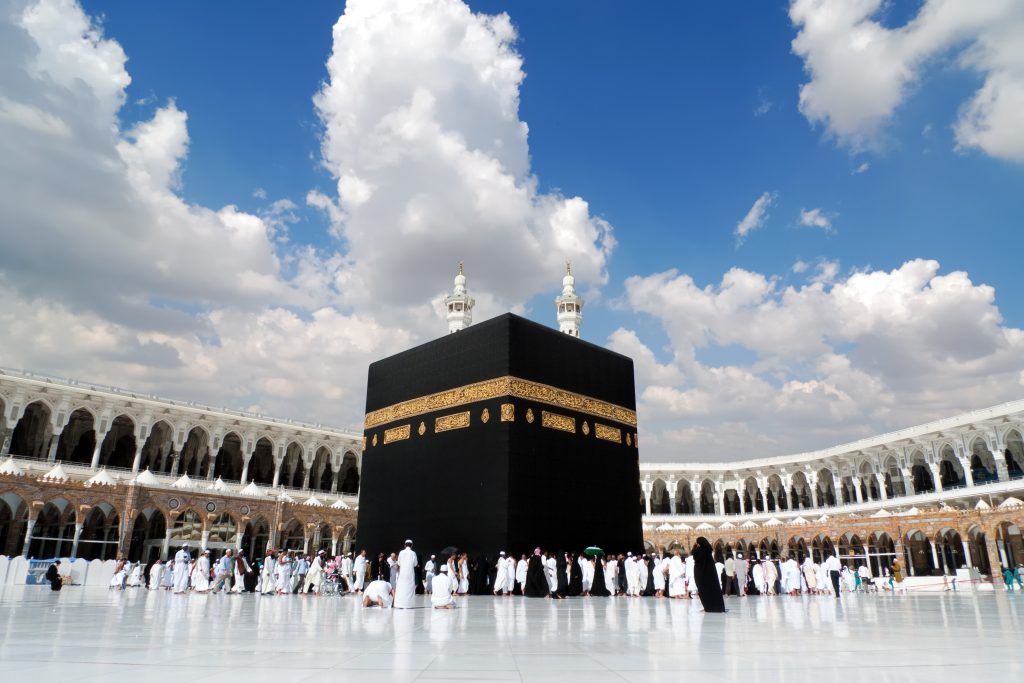
Dear brothers and sisters! Know that, Makkah is not merely a geographic point on a map; it is the spiritual axis of the universe, and its protection is guaranteed by Allah Almighty, the Lord of the Worlds. From the ancient military march of Abraha al-Ashram to the bloody modernist treachery of Juhayman al-Otaybi, and extending into today’s proxy conflicts where Houthi drones cross the red line toward the Noble Sanctuary, the Ka’abah has faced persistent existential threats. Yet, every physical assault serves only to unveil a deeper spiritual reality: tyrants fall, kingdoms shift, and geopolitical factions dissolve, but the Sacred House of Allah remains unshakeable and eternal.
Beloved brothers and sisters! Look back through the corridors of time to the year 570 CE—Amal-Fil, the Year of the Elephant. Step into the shoes of the Quraysh, who stood paralysed with fear, as Abraha, the Viceroy of Abyssinia, marched upon Makkah with a terrifying weapon of mass destruction. He brought an army equipped with war elephants, intended to stomp the Ka’abah into dust and divert the world’s devotion to his own secular cathedral.
The psychological terror was absolute. Abdul Muttalib, the caretaker of the Sanctuary, stood before the tyrant. He did not plead for the Ka’abah. He requested only his camels. When mocked by Abraha for prioritising livestock over the temple, Abdul Muttalib uttered the eternal words of unwavering psychological certainty. He said:
“I am the lord of the camels. As for the House, it has a Lord Who will protect it.”
When the human defenders fled to the mountaintops, leaving the valley utterly defenseless, the elephant Mahmud knelt. It refused to move forward toward Makkah. And then, the sky darkened. Not with armies of men, but with flock after flock of Tayran Ababil—seemingly fragile birds bearing baked clay stones.
The lesson here is sharp and piercing: When Allah decides to protect His Sanctuary, the most imposing military machinery is rendered as fragile as chewed straw.
Respected brothers and sisters! Fast-forward fourteen centuries to a cool dawn on November 20, 1979. The year was 1400 AH—the turn of the Islamic century. Over 50,000 peaceful pilgrims gathered around the Ka’abah for Fajr. As the final Taslim echoed through the courtyard, a dark, internal spiritual disease manifested.
Juhayman al-Otaybi and his group of heavily armed ideological extremists masqueraded as reformers. They brought in weapons hidden inside funeral coffins, locked the gates of the sanctuary, held thousands of innocent Muslim believers hostage, and falsely proclaimed a manufactured “Mahdi” from the microphone of the Haram.
For two horrific weeks, the Tawaf ceased. The holiest sanctuary became a battlefield. The psychological wound to the Ummah was catastrophic: How could the House of Peace be filled with gunsmoke?
Yet, this tragedy exposed a vital spiritual reality. Those who claim to fight for Islam while violating the sanctity of the innocent and desecrating the Haram are universally humiliated. Juhayman’s false messiah was killed, his movement dissolved, and the doors of the Grand Mosque were scrubbed clean of the blood of extremists. The Ka’abah outlived the zealots, proving that faith cannot be hijacked by the unstable or the self-righteous.
Fellow Muslims! Turn your eyes to the realities of our modern world. In recent weeks, the regional conflicts of the Middle East have repeatedly crossed a dangerous psychological boundary. The Saudi Air Defense Forces intercepted and destroyed a Houthi combat drone targeting the skies directly outside the restricted airspace of Makkah.
The Houthi factions issue denials, attempting to frame their actions within a conventional military campaign against Saudi targets. But let us speak with absolute candor: Wallahi, any explosive drone launched along a flight path toward Makkah is an intolerable provocation to over two billion Muslim believers globally.
Dear servants of Allah! Makkah is not an ordinary political asset; it is the Qiblah of the Ummah. Targeting this region with lethal weaponry—regardless of political rationale—is a direct repeat of the arrogance of Abraha. It forces us to ask a deep psychological question: How desensitised has the human ego become to risk global spiritual catastrophe for fleeting political leverage?
Respected servants of Allah! What do these historical cycles mean for us today?
- True Security belongs to Allah
Throughout history, whenever the material defenders of Makkah were weak, Allah intervened via miraculous means. When modern technology is used, Allah guides the interceptors. Do not let fear weaken your hearts.
- Recognise False Messiahs and False Flag Retribution
Whether it is Juhayman utilising the Haram for political clout, or modern Houthi militias pretending to champion regional justice while shooting missiles near the Ka’abah—the metric is clear. If an ideology threatens the House of Allah, it is inherently devoid of divine guidance.
- Purify Your Personal Qiblah
The external threats to the Ka’abah are signs of an internal decay within the hearts of the Ummah. We must protect our personal devotion with the same intensity that we expect the Haram to be physically defended.
My beloved people! The focal point of the global Muslim Ummah, the Qiblah, stands as a sacred “red line” for over two billion Muslim believers worldwide. In mid-September 2026, geopolitical tensions reached a critical threshold when the Saudi-led coalition announced that its air defenses intercepted a Houthi drone flying on a trajectory toward Makkah, sparking widespread condemnation from international bodies like the Organisation of Islamic Cooperation (OIC).
Respected servants of Allah! Know that the heart of this Ummah does not pump blood through borders of clay, sand, or political allegiance. It pumps life from a single, eternal center: The Noble Ka’abah.
Five times a day, every day, from the frosted windows of Scandinavia to the humid plains of Indonesia, over two billion souls bow their heads in exact alignment toward one brick-and-stone house built by Prophet Ibrahim (AS) and purified by Prophet Muhammad (Peace be upon him).
When reports surface of threats traveling along flight paths toward our sanctuary, it sends a tremor through the collective soul of every Muslim believer. The Qiblah is not merely a geographic coordinate on a map; it is our spiritual gravity. It is the anchor of our sanity in a chaotic world.
Dear brothers and sisters! Let it be known clearly. The sanctity of Makkah and Madinah is a divine red line. Allah the Almighty has guaranteed the protection of His House, declaring in Surah Al-Fil how He dealt with the companions of the elephant who marched with malice in their hearts against the Ka’abah. While earthly factions engage in political warfare, the global Ummah must rise above partisan divides to affirm one undeniable truth—the sanctuaries of Islam belong to all Muslims, and their peace is non-negotiable. We pray for the safety of the pilgrims, the protection of the land of revelation, and the binding of our fractured hearts into a unified wall of faith.
Respected brothers and sisters! In the modern landscape of warfare, drones and ballistic missiles are weighed by payload, range, and strategic impact. But when a weapon is fired on a path that intersects with Makkah or Madinah, the arithmetic changes completely. It ceases to be a regional conflict and morphs into a profound psychological assault on the collective consciousness of the Muslim world.
Fellow brothers and sisters! Why does a threat to the Qiblah sting more than any political loss?
For a Muslim believer, the Qiblah represents absolute certainty. In a world of moving goalposts, shifting morality, and volatile politics, the Ka’abah stands completely still. Threatening it feels like an attempt to erase the bedrock of Islamic identity.
The Haram is designated as a place of absolute safety. It is where the king and the labourer discard their worldly titles, on two simple white sheets, and stand shoulder to shoulder. To breach that safety with the anxiety of warfare is to violate the ultimate human equalizer.
Even amid denials and political counter-claims, the mere anxiety of a threat to the noble sites acts as a catalyst. It forces the Ummah to look past localised geopolitical biases and remember that what unites us globally is infinitely more sacred than the temporary disputes that divide us.
The sun was beginning to dip below the rugged mountains surrounding Makkah, casting a golden hue over the white marble court of the Grand Mosque. An elderly pilgrim from a war-torn province sat quietly against a pillar, his eyes fixed on the black silk of the Kiswah. His hands trembled, heavily lined with the scars of a lifetime of hardship. Beside him sat a young student from a completely different continent, scrolling through breaking news alerts on his phone about drones, air defenses, and regional escalations.
“They say a weapon was flying this way,” the youth whispered, his voice tense with modern anxiety.
The old man didn’t look at the phone. He simply looked at the Ka’abah, where hundreds of people were peacefully circumambulating in a seamless wave of devotion.
“Son,” the old man said gently, “I have seen empires rise and fall in my lifetime. I have seen regimes crumble and generals turn to dust. But look at that House. Before you and I were a thought in our mothers’ minds, people walked around it. Long after our bodies have returned to the earth, people will continue to walk around it. Men may try to leverage its name for their wars, but the Owner of this House has already decreed its victory. Our job is not to fear for the Ka’abah—Allah protects His own. Our job is to fear for our own hearts, ensuring they remain pointing toward it in truth, sincerity, and unbroken unity.”
Respected servants of Allah! Today, we witness the recurring transgressions of the Houthi militia, an ideological offspring of foreign agendas, raining down missiles and drones upon civilian airports, cities, and energy infrastructures. These are not mere political strikes; they are a direct transgression against the entire Ahlus-Sunnah wal Jama’ah, an assault on the peace of Muslims performing Umrah, and an attempt to terrorise the secure.
As our prominent Islamic scholars and the Saudi Grand Mufti Sheikh Saleh Bin Fawzan Al-Fawzan have explicitly declared:
“Protecting this great nation and punishing anyone who seeks to lay a hand on even an inch of its territory are among the greatest duties and most virtuous acts of devotion, for which lives and souls may be sacrificed.’ Rise, O soldiers on the borders! Stand firm, for you are the protective shield of the Ummah against the extremists, terrorists, Khawarij of our time and the proponents of sectarian corruption!”
Know, dear brothers and sisters, that the targeting of infrastructure supplying the Prophet’s Mosque in Madinah or civilian hubs like King Khalid International Airport is a clear manifestation of Fasad fil-Ard, corruption on earth.
We the Muslim Ummah, stand firmly behind the legitimate leaders and support every measure taken by the Kingdom of Saudi Arabia to safeguard its sovereignty.
Pray for Saudi troops, seek forgiveness of Allah, and guard your minds against the subversive ideologies aimed at destabilising the cradle of Islam.
The thunderous roar of the interceptor missile over Riyadh echoed an old, painful memory for Abu Fahad, a Yemeni-born Salafi volunteer stationed on the Saudi border. Thirteen years ago, he was a student of knowledge at the famous Dar al-Hadith seminary in Dammaj, Yemen. He vividly remembered the brutal blockade when Houthi snipers and artillery held their peaceful village hostage simply because they refused to accept their deviant doctrines. They were forced to leave their homes behind.
Now, standing on the rugged terrain of the southern border under the direct military leadership of the Arab Coalition, Abu Fahad looked at the horizon. He was no longer just a displaced student; he was a defender of the Sanctuary. When news reached his camp that a Houthi strike killed a traveling Islamic scholar at King Khalid International Airport, a quiet resolve settled over the troops.
Abu Fahad adjusted his gear, remembering the instructions of the Islamic scholars: Obedience to the field commanders, precision in execution, and complete reliance on Allah. This was not a war for land; it was a psychological and spiritual stand to protect the pure creed and Aqidah from being extinguished by an armed proxy militia.
The International Islamic Fiqh Academy (IIFA) along with mainstream Salafi bodies have uniformly categorised the Houthi drone and missile salvos into Saudi Arabia as categorically prohibited criminal acts. In Salafi jurisprudence, the blood, wealth, and honour of a Muslim are sacrosanct. Dropping explosive payloads onto crowded civil structures violates the foundational objectives of Islamic Shari’ah, Maqasid al-Shari’ah, specifically the preservation of life and human security.
Ahlus-Sunnah views the Houthi movement not merely as a political entity, but as an ideological deviation rooted in extreme sectarianism and backed by external regional powers. Their systematic strikes against regions bordering or serving the noble sanctuaries of Makkah and Madinah are interpreted by Islamic scholars as an existential threat to orthodox Sunni Islam.
According to the foundational Ahlus-Sunnah principles of Al-Wala’ wal-Bara’, Loyalty and Disavowal, and obedience to the legitimate Muslim authority, defending Saudi territory is an elevated act of worship. Active resistance against the Houthis is framed as a legitimate defensive struggle to deter aggression and maintain the geopolitical stability required for the preservation of the faith.
The recent Houthi escalations against Saudi Arabia’s sovereignty—striking civilian hubs and threatening international aviation—expose a profound spiritual deviance.
Psychologically, these attacks seek to plant fear in the hearts of the Muslim believers and disrupt the stability that allows millions to practice their religion safely. But instead of fear, the aggression breeds a profound spiritual awakening and motivation among the Ummah.
When the Houthi militia targets Madinah’s power grids or Riyadh’s airports, they strike at the heart of global Islamic traffic. For the Muslim believer, this is a clear sign that the conflict is not merely political; it is a defense of the purity of Islamic belief against a group that historically reviles the Companions of the Prophet Muhammad (Peace be upon him) and distorts the core tenets of the faith. The response of the Muslim believer must be steadfastness, compliance with the rightful leaders, and unwavering support for the defense forces keeping the sanctuaries secure.
Dear brothers and sisters! On a Saturday morning at King Khalid International Airport in Riyadh, the passenger terminal was buzzing with pilgrims arriving from every corner of the world, eager to make their way to Makkah for Umrah. Among them was Sheikh Nasrullah Al-Badr, a widely respected Islamic scholar from Bangladesh. He had spent years teaching the pure Sunnah of Prophet Muhammad (Peace be upon him), and this trip was a lifelong spiritual goal.
As the Sheikh stood near the terminal windows, a sudden explosion from a Houthi-directed projectile tore through the facility, filling the air with smoke and shattering glass. In that single act of cowardice, the lives of 12 innocent civilians—including Saudi citizens and foreign nationals from the US, Jordan, and Sudan—were cut short. Sheikh Nasrullah Al-Badr was among those killed.
When news of the attack reached the Islamic scholars and the Ummah, it did not break their spirit; it ignited an unshakeable resolve. The Yemeni Religious Islamic Scholars Association immediately issued a severe warning:
“Targeting a civilian facility crowded with people is a crime unanimously forbidden in Islam. Anyone involved in, financing, or justifying these acts shares the burden of this massive sin.”
The story of the Sheikh became a rallying cry for the soldiers on the southern border. They realised they were not just fighting a geopolitical skirmish; they were standing as a shield for the defenseless, protecting Islamic scholars, elders, women, and children who come to the Kingdom solely to worship Allah. The grief transformed into an intense, activational motivation to eradicate the threat completely.
Inna lillahi wa inna ilaihi raji’un! Inna lillahi wa inna ilaihi raji’un!! Inna lillahi wa inna ilaihi raji’un!!!
Dear servants of Allah! Today we reflect upon a profound manifestation of Allah’s decree, woven with both deep sorrow and immense spiritual triumph. We look to our beloved brother, the respected Islamic scholar, grand mufti, and respected teacher from Bangladesh—Sheikh Nasrullah Al-Badr.
He did not leave his home for worldly gain, nor did he seek wealth or power. He left Dhaka leading a delegation of 44 pilgrims, journeying toward the House of Allah. He was bounded by love, dressed in the pure, white sheets of Ihram. Consider the psychological state of a Muslim believer in Ihram—the ego is completely stripped away, the tongue repeats the Talbiyyah, ‘Labbaikallahummah Labbaik’, and the heart is entirely anchored to the Divine.
While transiting through King Khalid International Airport in Riyadh, a sudden, devastating explosion claimed his life and the lives of other innocent souls. To human eyes, it is a senseless tragedy born of worldly malice. But to the eyes of faith, it is a magnificent departure. The Prophet Muhammad (Peace be upon him) said regarding a man who died while in the state of Ihram:
“Wash him with water and lotus leaves, and shroud him in his two garments… for Allah will raise him on the Day of Resurrection reciting the Talbiyah.'” [Sahih al-Bukhari]
Imagine the scene on the Day of Judgment! While multitudes are gripped by fear, Sheikh Nasrullah will rise from his grave, not in terror, but calling out to his Lord: ‘Here I am, O Allah, here I am!’ This is not just a death; it is an awakening of the soul, a motivational reminder that how we live dictates how we leave this world.
Dear brothers and sisters! The targeting of airports, crowded terminals, and innocent travelers is a grave violation of the very core of Islamic law, which protects the sanctities of life and peace. Sheikh Nasrullah was a beacon of knowledge who spent his short 37 years teaching the Word of Allah. The loss of a scholar is a fracture in the Ummah.
Yet, let this motivate your souls. Let it activate your resolve. Do not let your hearts despair. The enemies of peace may cut short an earthly life, but they cannot erase a legacy. Sheikh Nasrullah’s final, silent phone call to his family in Dhaka—where he could not speak a word due to the chaos—serves as an emotional testimony that our time here is brief. Work for the Next Life, purify your intentions, and remember that when Allah loves a servant, He chooses an honourable end for them.
The terminal at King Khalid International Airport was buzzing with the murmurs of travelers, families, and pilgrims. Sheikh Nasrullah sat among his students, the white cloth of his Ihram symbolising total submission. His mind was already hovering over the Ka’abah. Suddenly, a deafening blast tore through the terminal, turning light into dense smoke and calm into terror.
In those frantic, final moments, trembling hands reached for a mobile phone. A call went through from Riyadh to Dhaka. On the other side, his brother answered eagerly, expecting a joyful update. But there were no words. Only the heavy, chaotic background noise of an emergency, the distant screams, and the fading breath of a teacher. Sheikh Nasrullah could not utter a word.
Psychologically, that silence speaks volumes. It was the silence of a soul transitioning away from a broken world. He left this world exactly as he lived it—in total devotion, wearing the garments of a pilgrim, leaving a legacy of patience for his family and students.
Sheikh Nasrullah was a protector. As an Imam and teacher, he felt a profound psychological responsibility for the 44 souls he was guiding to Umrah. He spent months preparing them, explaining the rituals, and assuring them of Allah’s mercy. His final act on this earth was standing by them, sharing their wait, and absorbing the trials of the journey with them. He entered the airport as their earthly guide; he left it as an architectural pillar of inspiration for Muslims worldwide, a martyr who died while serving the guests of Allah.
This tragic passing of the widely respected Bangladeshi Islamic scholar, Mufti, Sheikh Nasrullah Al-Badr, in a brutal strike on Riyadh’s airport, sends a profound psychological jolt through the global Muslim Ummah. It forces us to confront a vital spiritual reality: evil is chaotic, but divine selection is precise.
Those who launched the attack sought destruction, chaos, and geopolitical leverage. But Allah, the Best of Planners, utilised that very moment to elevate a humble servant. To be taken while dressed in Ihram is an honour reserved for a select few. It is an activational call to the youth of the Umrah: do not delay your spiritual transformation. We often think we will seek Allah when we are old. Sheikh Nasrullah was only 37. He lived with urgency, taught with passion, and was reclaimed by his Creator in the ultimate state of purity.
When news broke that Sheikh Nasrullah Al-Badr had succumbed to his injuries following the airport attack, a dark cloud of grief fell over his hometown and his Islamic schools. His final, wordless phone call to his brother in Dhaka remains a poignant, emotional anchor for all who knew him.
But let us look past the grief. Let us find the deep psychological strength within this tragedy. The Islamic scholar who spent his life speaking, lecturing, and teaching the Qur’an was silenced by a physical blast—yet his death has become a louder, more powerful sermon than any spoken word. It teaches us that our lives are defined by our trajectories. He was moving toward Allah, and Allah met him halfway. His martyrdom reminds us to keep our intentions pure, to stand firmly against oppression and terror, and to live lives so beautifully aligned with the faith that even our sudden departures become a source of guidance for the world.
Ya Allah, protect Your Sacred House from the plots of the transgressors, from the innovations of the extremists, and from the missiles of the tyrants. Turn their schemes back upon themselves, and keep Makkah a place of security and peace for all Muslim believers until the Day of Judgment, ameen.
All praise is due to Allah, Lord of the worlds. May the peace, blessings and salutations of Allah be upon our noble Messenger, Muhammad, and upon his family, his Companions and his true followers.
Murtadha Muhammad Gusau is the Chief Imam of Nagazi-Uvete Jumu’ah and the late Alhaji Abdur-Rahman Okene’s Mosques, Okene, Kogi State, Nigeria. He can be reached via: gusauimam@gmail.com or +2348038289761 or +2348024192217.
This Jumu’ah Khutbah (Friday sermon) was prepared for delivery today, Friday, Jumadal Ula 05, 1448 AH (Octorber 16, 2026).