
By Bilesanmi Abayomi
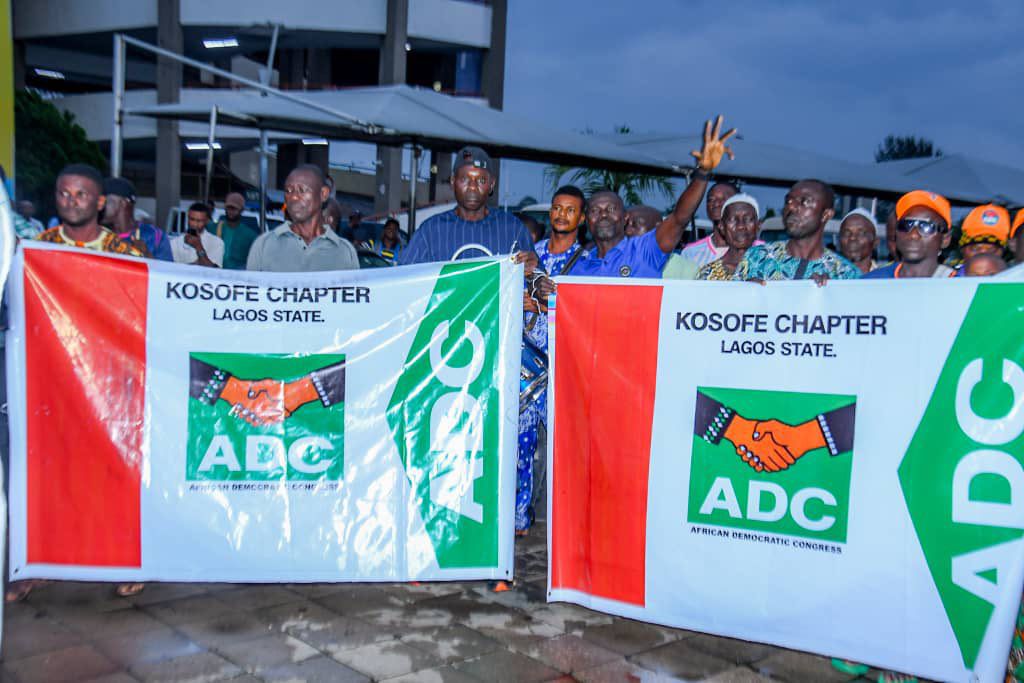
The appearance of a banner bearing the insignia of the African Democratic Congress (ADC) and featuring notable political figures previously affiliated with the All Progressives Congress (APC) and Peoples Democratic Party (PDP) has stirred political tension and debate across Kosofe Local Government Area.
The banner, which surfaced recently within the constituency, has triggered speculation over a possible realignment of forces ahead of the 2027 general elections, with some political watchers interpreting it as the early signs of a new opposition coalition taking root in the area.
Reactions to the development have been swift and varied, reflecting the political fault lines that define the Kosofe space.
APC Stakeholders Dismiss ADC’s Emergence
Odeyemi Richard, a member of the Kosofe School-Based Management Committee (SBMC) and an APC loyalist, dismissed the ADC banner as inconsequential, likening it to the fleeting wave of the 2023 “Obidient” movement.
“The ADC will eventually reduce to nothing, no matter who they are or what they plan to do,” he stated. “Just like in the days of the ‘Obidients’, we are watching. The progressive will remain stronger and greater in Kosofe.”
Oloye Salami Oluwaseun, another APC stalwart, was more scathing in his criticism. He accused the ADC promoters of lacking grassroots support and being driven by self-serving political contractors.
“The people featured in the ADC banner were hired by a political contractor who cannot even deliver a single polling unit in his own ward,” he said. “The promoters of this so-called coalition are expired politicians. Hon. Rahman Owokoniran should be reminded that politics is local, and he has no stake in Kosofe.”
Civil Society, Analysts Call for Caution and Reflection
While pro-APC voices have sought to downplay the banner’s significance, other observers offered a more measured response.
Taiwo Lasisi, President of the Ta’awun Political Forum in Lagos, acknowledged the symbolism of the ADC move and used the opportunity to critique the prevailing socio-economic conditions in the country.
“This seems more like a prayer than a reflection of Nigeria’s political realities,” Lasisi said. “The persistent rise in commodity prices, insecurity, and other issues must be addressed. Pretending that the status quo will favor a particular party in 2027 is a mirage.”
He warned that voter sentiment is shifting as a result of economic hardship, and the ruling party may not be able to rely on past dominance if urgent reforms are not implemented.
“Even the Yoruba adage says, ‘Failure of the living is the reason for seeking the help of the dead in worldly affairs.’ APC must act now or risk the consequences.”
A Political Landscape in Flux
With nearly two years until the next general election, the political temperature in Kosofe is already rising. The emergence of the ADC banner may be symbolic, but it has succeeded in igniting conversation and drawing attention to underlying political dissatisfaction.
While the APC continues to project confidence in its grassroots structure and dominance, the ADC’s manoeuvre—regardless of its immediate impact—has brought fresh attention to the potential for political realignment in Lagos’ local councils.
Whether this signals a serious threat or simply early campaign theatre, only time—and the performance of incumbent officeholders—will tell.