
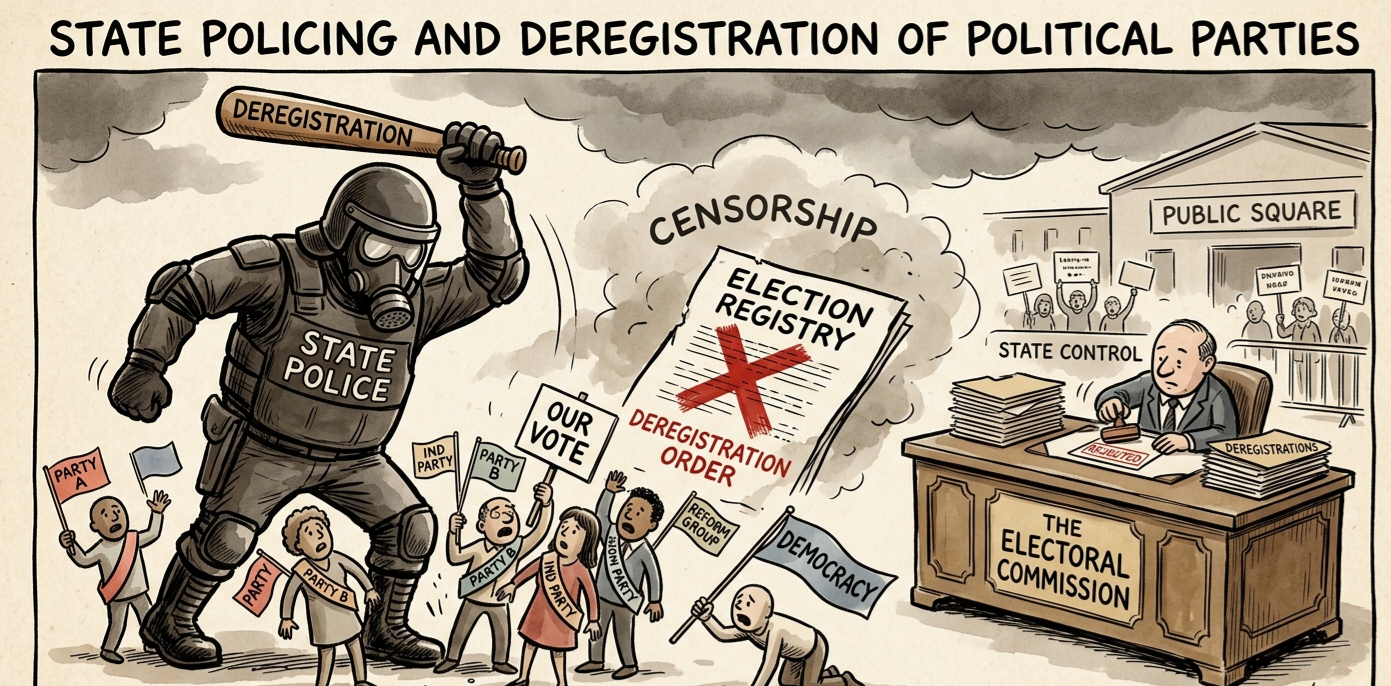
State policing and deregistration of political parties…
By Bola BOLAWOLE
turnpot@gmail.com 0807 552 5533, 0803 251 0193
(Published in the TREASURES column on the back page of the New Telegraph newspaper edition of Wednesday, 17June, 2026).
This is the first time I will feature Dr. Olukayode Ajulo, OON, SAN, as Guest Columnist on this page. He is the Ondo State Attorney-General and Commissioner for Justice. He is, arguably, one of the most active government officials of his status on social media. Very cerebral and confident of his convictions, he addresses two burning issues here today: State policing and the Federal High Court judgment directing the Independent National Electoral Commission (INEC) to deregister four political parties.
Ajulo discusses the need for the creation of State Police, saying it is the completion of Nigeria’s Federal project, citing as examples countries such as the United States of America, Canada and India which maintain multi-layered policing structures that reflect their Federal character; he also cites legal authorities to justify the Federal High Court judgment that threatens to fundamentally alter the shape of electoral contests, beginning with the off-season governorship elections coming up in a few weeks in Ekiti and Osun state. Excerpts:
“History teaches a simple but profound lesson: When a State struggles to guarantee the safety of its citizens, every other promise of the government becomes uncertain. Economic prosperity retreats before insecurity. Education suffers when children fear going to school. Agriculture declines when farmers abandon their farms. Investment evaporates where criminality flourishes. Ultimately, the legitimacy of government itself is tested by its capacity to secure life and property.
“It is, therefore, no coincidence that the framers of the Constitution of the Federal Republic of Nigeria, 1999 (as amended) placed security at the heart of governance. Section 14(2)(b) provides in clear and unequivocal terms that ‘The security and welfare of the people shall be the primary purpose of government’.
“This constitutional declaration is neither ornamental nor aspirational. It is the foundational obligation of the Nigerian State. Every institution of government derives legitimacy from its capacity to fulfil this sacred constitutional mandate.
“Today, however, Nigeria confronts a security reality, vastly different from that contemplated by earlier generations. Terrorism, banditry, kidnapping, farmer-herder conflicts, communal violence, organised crime, cybercrime and transnational criminal networks have exposed the limitations of a highly centralised security architecture.
“At the centre of this debate lies Section 214(1) of the Constitution, which provides that ‘There shall be a police force for Nigeria, which shall be known as the Nigeria Police Force and, subject to the provisions of this section, no other police force shall be established for the Federation or any part thereof.’
“For decades, this provision has maintained an exclusive Federal monopoly over policing. While conceived with the legitimate objective of preserving national unity, experience has demonstrated that a nation of over 200 million people, spread across diverse ethnic, linguistic, geographical and cultural communities, cannot indefinitely rely upon a singular centrally-controlled policing structure.
“The question before Nigeria today is, therefore, not whether security should remain a national responsibility. I firmly believe it must. The question is whether security can be more effectively achieved through a constitutional framework that combines Federal coordination with local responsiveness. The growing consensus across the Federation suggests that the answer lies in the establishment of State Police.
“The agitation for State Police is often misunderstood as a call for fragmentation. It is nothing of the sort. Rather, it is a call for the completion of Nigeria’s Federal project. Federalism is not merely a constitutional arrangement; it is a philosophy of governance founded upon the principle that public authority should be exercised at the level closest to the people, except where compelling national interests require otherwise.
“The Supreme Court has repeatedly affirmed the Federal character of the Nigerian constitutional order. In Attorney-General of Ogun State v Attorney-General of the Federation (1982) 3 NCLR 583, the Court emphasised, and rightly so, that powers within the Federation are constitutionally distributed between the Federal Government and the States. Similarly, in Attorney-General of Lagos State v Attorney-General of the Federation (2004) 18 NWLR (Pt. 904) 1, the Supreme Court reaffirmed that neither level of government is intended to be subordinate to the other within its constitutional sphere.
“The logic underlying these decisions is unmistakable: Federalism thrives where responsibility follows capacity, and where governance remains responsive to local realities.Security, therefore, is no exception.
“A Police officer recruited from, familiar with, and accountable to a local community possesses advantages that no centrally-deployed officer can easily replicate. Such an officer understands local languages, customs, terrain, social networks and emerging threats. He is not merely stationed within the community; he is part of it.
“Sir Robert Peel, regarded as the father of modern policing, famously observed that ‘The Police are the public, and the public are the Police’. This principle remains as relevant today as it was in nineteenth-century England. Effective policing depends not merely on force, but on trust, local intelligence and community cooperation. State Police, it must be emphasised, seeks to institutionalise these principles within the Nigerian Federation.
“Nigeria’s current centralised policing arrangement is increasingly an anomaly among Federal systems. The United States operates Federal, State, County and Municipal Police institutions. Canada combines Federal policing with Provincial and local police services. Germany, Australia and India similarly maintain multi-layered policing structures that reflect their Federal character.
“James Madison, one of the principal architects of American federalism, explained in Federalist No. 45 that ‘The powers delegated by the proposed Constitution to the federal government are few and defined. Those which are to remain in the State governments are numerous and indefinite.’ The wisdom behind this principle lies in the recognition that governance becomes more effective when local institutions are empowered to address local challenges. Nigeria’s security challenges increasingly demand a similar constitutional evolution.
“Paradoxically, one of the strongest arguments for State Police is not merely efficiency, but liberty. The concentration of coercive power in a single institution has always troubled constitutional thinkers. Montesquieu warned that ‘Constant experience shows us that every man invested with power is apt to abuse it’. Lord Acton later echoed the same concern that ‘Power tends to corrupt, and absolute power corrupts absolutely.’ The constitutional response to this danger has never been the elimination of power, but its distribution, regulation and accountability.
“State Police, properly constituted and effectively supervised, represents not an expansion of arbitrary power, but a diffusion of authority within a framework of constitutional safeguards. In truth, Federalism itself is one of humanity’s most successful mechanisms for preventing the excessive concentration of governmental power.
“The ongoing constitutional amendment process provides a historic opportunity to modernise Nigeria’s security architecture. The proposed framework contemplates the establishment of two constitutionally-recognised policing institutions: A Federal Police Service responsible for national security, inter-State crimes, terrorism, border protection and other federal concerns; and State Police Services established by individual States through legislation enacted by their respective House of Assembly.”
Dr. Ajulo then elaborately itemised the legal routes that will give birth to State Police while also allaying fears of its abuse by State governments: “Critics of State Police frequently raise concerns about abuse by state governments. These concerns are legitimate and deserve serious engagement (but) the answer to potential abuse is not perpetual centralisation. The answer is robust constitutional safeguards…’
Dr. Ajulo also argues that “Support for State Police does not imply hostility to federal authority”, adding that the relationship between both “should resemble a partnership, not a rivalry.” He also advised the country to learn from history so as to avoid the pitfalls that dogged the path of local policing during the First Republic.
Dr. Ajulo’s views enunciated above agree substantially with mine.
On the judgment ordering the INEC to deregister some political parties, Dr. Ajulo has this to say:
“Since Justice Peter Lifu delivered his judgment deregistering the ADC, Accord Party and others, the public square has erupted with outrage, conspiracy theories and familiar accusations of political manipulation. Fingers are being pointed in every direction and, as usual, President Bola Ahmed Tinubu has become the preferred destination for political frustration.
“But beneath the fog of partisan emotions lies one inconvenient truth: Justice Lifu did not create the law; he merely read it. That distinction is everything.
“Section 225A of the 1999 Constitution (as amended) speaks with unusual clarity. Political parties are required to attain stipulated electoral thresholds or face deregistration by INEC… Even more importantly, these provisions did not suddenly emerge from the desk of President Tinubu. They were products of constitutional amendments assented to in 2018 by the late President Muhammadu Buhari. The legal architecture predates this administration and belongs not to any individual but to the Nigerian state itself.
“Justice Lifu merely interpreted what had already been enacted. He did not legislate from the Bench. He did not embark on judicial adventurism. He did not engage in constitutional creativity. He simply performed the sacred duty expected of every disciplined jurist: applying the law as written.
“As Lord Denning would likely remind us, judges interpret laws as they are, not as politicians wish them to be… Before any serious Nigerian joins or builds a political party, the first obligation ought to be legal due diligence…
“The constitutional framework now being criticised emerged during the Buhari administration. Among those who stood at the centre of that government were some of today’s leading political actors and candidates of the ADC – David Mark, Rotimi Ameachi, et al!
“The then Attorney-General and Chief Law Officer of the Federation, Abubakar Malami, SAN, was the principal custodian and defender of the legal architecture of that era. The same constitutional order now attracting criticism passed through the legal machinery over which he exercised significant influence (but) now he is the ADC gubernatorial candidate in Kebbi State!
“History occasionally writes satire better than novelists!”
While I agree with Dr. Ajulo that recent events tend to show that some of our top politicians have not been clinical enough as they hop from one political platform to another, I do not think we have heard the last words on this matter. The appellate courts may still make pronouncements. Rather than celebrate too early, we should keep our fingers crossed for now!
Former editor of PUNCH newspapers, Chairman of its Editorial Board and Deputy Editor-in-chief, BOLAWOLE was also the Managing Director/Editor-in-chief of The Westerner news magazine. He writes the ON THE LORD’S DAY column in the Sunday Tribune and TREASURES column in New Telegraph newspaper on Wednesdays. He is also a public affairs analyst on radio and television.