
By Bilesanmi Abayomi
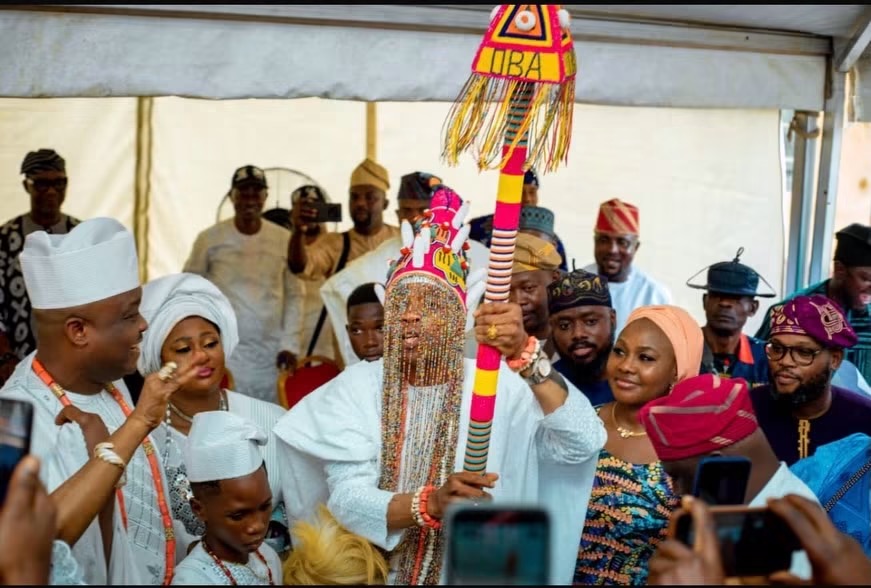
The recent installation of Oba Kabir Adesegun Saliu as the new Olu Oko Baba Agba monarch in Kosofe, Lagos State, has triggered reactions among political and community stakeholders, bringing underlying tensions within the area’s traditional and political structures into sharper focus.
The installation ceremony, held at the Kosofe Local Government Secretariat, was conducted with the participation of officials from the Lagos State Ministry of Local Government, Chieftaincy Affairs and Rural Development, alongside prominent traditional rulers.
However, the conspicuous absence of the Oloworo of Oworonshoki, HRM Oba Babatunde Saliu Elebo II, became one of the major talking points surrounding the ceremony, particularly given the kingdom’s proximity to the Olu Oko Baba Agba domain.
‘Chicken-Eat-Chicken’ Politics
Reacting to the development, former Kosofe Local Government Supervisor for Boundaries Matters, Ganiyu Olamiji Oyebanjo (GOCO), described the situation as an indication of the intense competition for influence within local traditional and political circles.
Speaking with KosofePost, Oyebanjo said the development reflected the broader factional struggles that can emerge where traditional authority, political influence and community interests intersect.
“If the Kosofe Local Government is peaceful politically and otherwise, the whole of Lagos State will be peaceful,” Oyebanjo said.
Describing the environment as “chicken-eat-chicken,” he argued that political and traditional actors sometimes turn against one another in their efforts to preserve relevance, influence and control.
According to him, coronations involving strategically important traditional stools can go beyond cultural celebrations, often becoming the visible outcome of negotiations and rivalries involving royal families, community factions and political stakeholders.
A Strategic Traditional Stool
The location of the Olu Oko Baba Agba Kingdom, situated around the Kosofe-Oworonshoki axis, further adds significance to the development.
The emergence of a new monarch in the area therefore has implications beyond the traditional institution, particularly because traditional leadership remains closely connected to community mobilisation, land matters, cultural authority and grassroots political influence.
Oba Kabiru’s voice behind the clip during the Oloworo Obaship tussle, supporting Prince Nurudeen prior to his installation as the new monarch of Oko Baba Agba kingdom
The development has consequently renewed attention on the relationship between traditional institutions and political actors in Kosofe, where competing interests can intersect around questions of legitimacy, jurisdiction and influence.
While the installation of Oba Kabir Saliu has formally ushered in a new phase for the Olu Oko Baba Agba Kingdom, the reactions surrounding the ceremony suggest that questions about traditional boundaries, relationships among royal institutions and the role of political actors may continue to shape discussions in the area.
For now, attention remains on how the various traditional and political stakeholders respond to the development and whether the emerging tensions can be managed without further deepening divisions within the Kosofe community.