
Imagine being asked to build schools for a community without knowing how many children will need them in the next five or ten years. How many classrooms would you build? How many teachers would you recruit? Where would you locate the schools?
For many education systems, this is not a hypothetical question. Poor, outdated or unavailable enrollment projections can leave governments making critical education investments without a clear picture of future demand.
In a recent analysis, Dr. Cecilia Adaja argues that effective education planning must begin with evidence about future needs, rather than construction projects based largely on historical enrollment figures.
Historical data can tell policymakers what has already happened. It cannot, on its own, tell them what is coming.
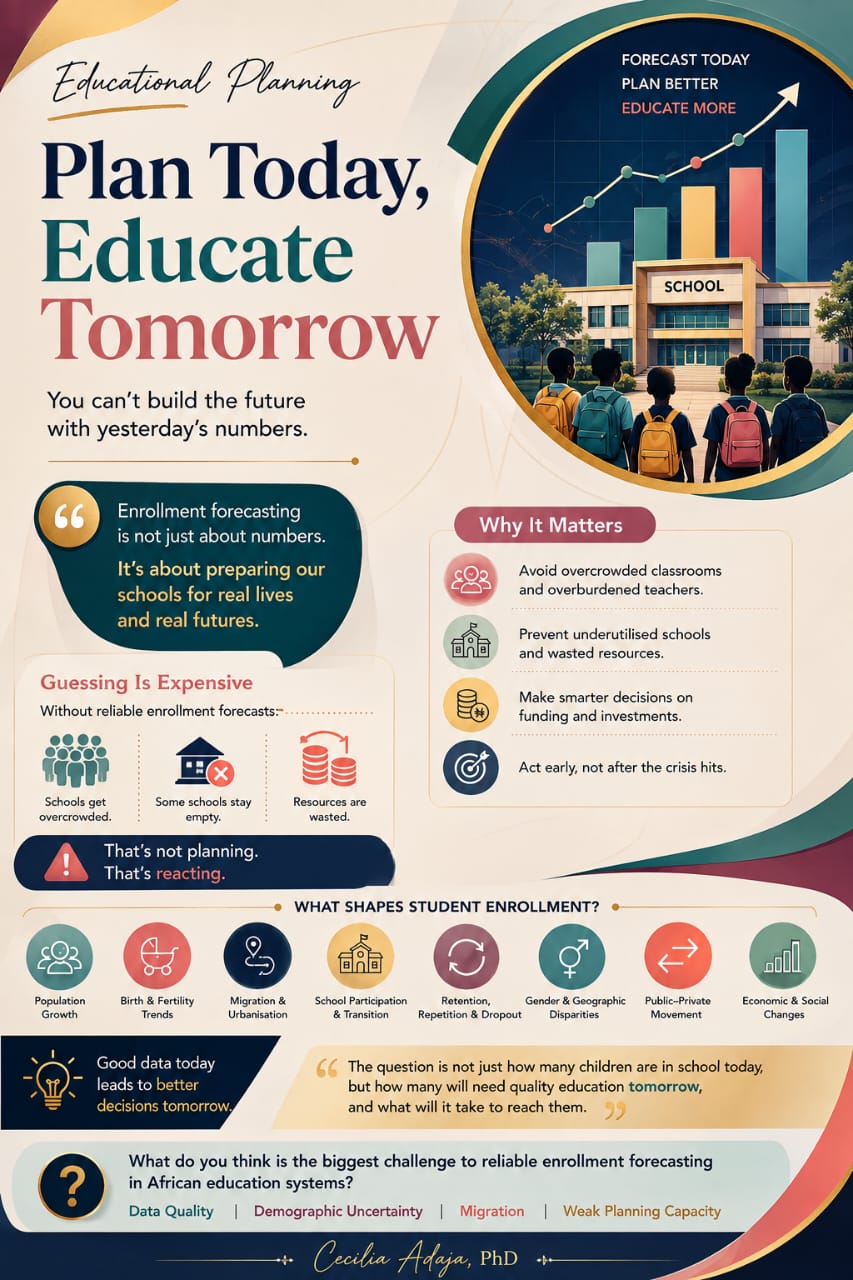
The Cost of Planning Without Foresight
When governments lack reliable enrollment forecasts, education planning can quickly become reactive.
Overcrowding: An increase in young families or a rapidly growing population can create demand for classrooms and teachers that existing infrastructure cannot accommodate.
Underutilisation: In communities experiencing declining school-age populations, continued construction without proper forecasting can leave governments with expensive facilities that are barely used.
Reactive spending: Instead of anticipating demand, education authorities are forced to respond to shortages after they have already become crises, often at greater cost.
Enrollment Is More Than a School Count
Adaja argues that meaningful enrollment forecasting requires policymakers to examine the demographic and social factors that shape demand for education.
These include population growth and changes in age structure; Birth and fertility rates; Migration and urbanisation; School participation and transition rates; Repetition and dropout rates; and Movement of pupils between public and private schools.
Together, these indicators provide a more realistic picture of where future education demand is likely to emerge.
Planning for Different Futures
But forecasting should not mean relying on one fixed prediction.
Populations change, economies fluctuate and migration patterns can shift rapidly. For this reason, effective education planning should incorporate scenario planning, allowing policymakers to model different possibilities, including rapid population growth, moderate growth or demographic decline.
Such scenarios can help governments determine how many schools and classrooms may be required, where teachers will be needed and how education budgets can respond to changing circumstances.
Ultimately, the question facing education planners should go beyond “How many children are currently in school?”
The more important questions are:
How many children will need quality education tomorrow? Where will they live? And what resources will the education system need to serve them?
Without that foresight, school construction, teacher recruitment and education budgets risk becoming exercises in educated guesswork.
Education planning should not wait for classrooms to become overcrowded before governments realise they needed to build more schools. The data should tell us what is coming before the crisis arrives.