
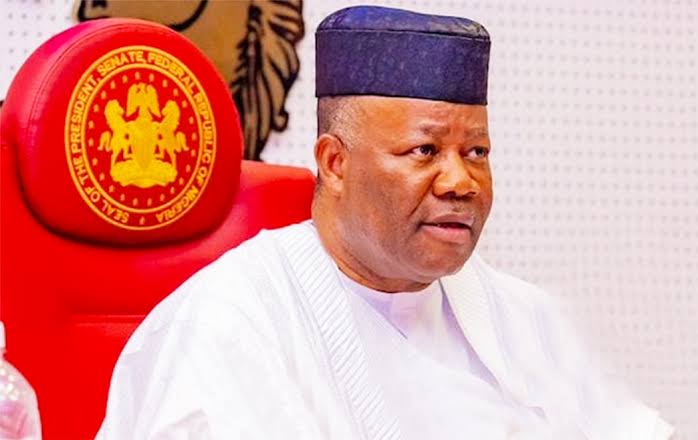
OPEN LETTER TO THE SENATE PRESIDENT, GODSWILL AKPABIO
On the Urgent Need to Criminalise the Deliberate Spread of Fake News and Strengthen National Information Security
Mogaji Wole Arisekola, the Chairman of the Association of Online Media Practitioners, has called on the Senate President, Godswill Akpabio, and the leadership of the National Assembly to urgently consider the enactment of stricter laws that will treat the deliberate spread and publication of fake news as a serious national security offence, potentially rising to the level of treason in extreme and proven cases of coordinated disinformation aimed at destabilising the country.
This appeal is anchored on growing concern over the increasing weaponisation of false information within Nigeria’s digital and political space. According to the Chairman of the Association of Online Media Practitioners, there is an urgent need for legislative intervention to address the alarming rise in fabricated stories, manipulated narratives, and intentionally misleading publications that have continued to damage public trust, incite tension, and undermine national cohesion.
The association has therefore called on the leadership of both the Senate and the House of Representatives to immediately commence a review of existing cybercrime and media-related laws to reflect the realities of the digital age, where information can be manufactured, amplified, and distributed within seconds to millions of unsuspecting citizens.
It was further lamented that recent comments reportedly attributed to the President of the United States, in which concerns were raised about the Nigerian media space being associated with fake news, have not done any good to the international image of the country. Whether such remarks are fully verified or politically interpreted, they nonetheless highlight a growing global perception problem that Nigeria can no longer ignore.
The unchecked proliferation of fake news has become a dangerous tool in the hands of politically motivated actors and opportunists who hide under the anonymity of social media to destabilise public order. These individuals often operate without accountability, distorting facts, fabricating statements, and circulating falsehoods capable of provoking ethnic, religious, and political tensions across the country.
Most disturbing, according to the statement, is that many of these actors are not trained journalists, nor are they subject to any professional ethical standards. They are often described as politically sponsored online operatives or “data boys” who are engaged purely for the purpose of pushing propaganda, misinformation, and character assassination campaigns against perceived opponents.
The statement described such individuals as “internet-based agents of disorder” who have turned digital platforms into instruments of confusion and national embarrassment. Their activities, it argued, go far beyond freedom of expression when they are deliberately structured to mislead the public and provoke instability.
In light of these developments, Arisekola and the association insist that Nigeria must take decisive steps to protect its democratic institutions, electoral integrity, and social harmony from the corrosive effects of organised disinformation networks. They argue that freedom of speech must never be confused with the freedom to deliberately endanger national peace.
The proposed legal framework, they suggest, should clearly distinguish between legitimate expression and intentional disinformation campaigns designed to incite violence or undermine state authority. In such extreme cases, they believe the law should not treat the offence lightly, as the consequences of mass misinformation can be as destructive as physical attacks on national institutions.
They further emphasised that countries across the world are already tightening regulations around digital content, misinformation, and cyber manipulation, and Nigeria cannot afford to lag behind in safeguarding its democratic space.
Ultimately, the call is for responsible governance, stronger regulatory enforcement, and a renewed commitment to protecting the integrity of information in the public domain. The survival of national unity, they argue, depends significantly on how well Nigeria manages the dangerous spread of false narratives in an increasingly digital and politically charged environment.