
Artificial Intelligence is no longer a future technology. It is already shaping how students search for information, complete assignments, create presentations, learn languages, write code, and even prepare for examinations.
The real question is no longer whether young people will use AI.
The question is whether schools will prepare them to use it wisely.
Many secondary school students are already experimenting with AI tools outside the classroom. Some use them productively to understand difficult concepts or improve their writing. Others rely on them so heavily that they struggle to think independently.
This is exactly why schools cannot afford to ignore AI.
Teaching AI in secondary schools should not mean turning every student into a programmer or machine learning engineer. Instead, it should focus on helping learners understand what AI is, what it can and cannot do, and how to use it responsibly.
Imagine a classroom where students learn to:
- Ask better questions instead of accepting the first answer they receive.
- Verify AI-generated information before believing or sharing it.
- Recognise bias and misinformation.
- Protect their privacy and digital identity.
- Use AI to strengthen creativity rather than replace original thinking.
- Understand the ethical implications of emerging technologies.
These are not simply technology skills. They are life skills.
At the same time, introducing AI into secondary education raises important concerns.
Many schools still lack reliable internet access, computers, electricity, and trained teachers. In some communities, students are still sharing textbooks or learning in overcrowded classrooms.
Should AI become another subject competing for limited resources?
Or should it be woven into existing subjects such as English, Science, Social Studies, Computer Studies, and Civic Education?
Another concern is assessment. If students can generate essays, solve mathematics problems, or produce project reports within seconds, how should schools evaluate genuine learning?
Perhaps the answer is not to ban AI but to redesign learning itself. Schools may need to place greater emphasis on critical thinking, collaboration, creativity, communication, and problem-solving—skills that remain uniquely human.
History shows that education has always evolved alongside major technological shifts. Calculators did not eliminate mathematics. The internet did not eliminate libraries. Instead, they changed what students needed to know and how they learned.
AI presents a similar opportunity.
The schools that prepare students to work with AI, while preserving curiosity, ethics, and independent thinking, may be the ones producing graduates who are best equipped for tomorrow’s world.
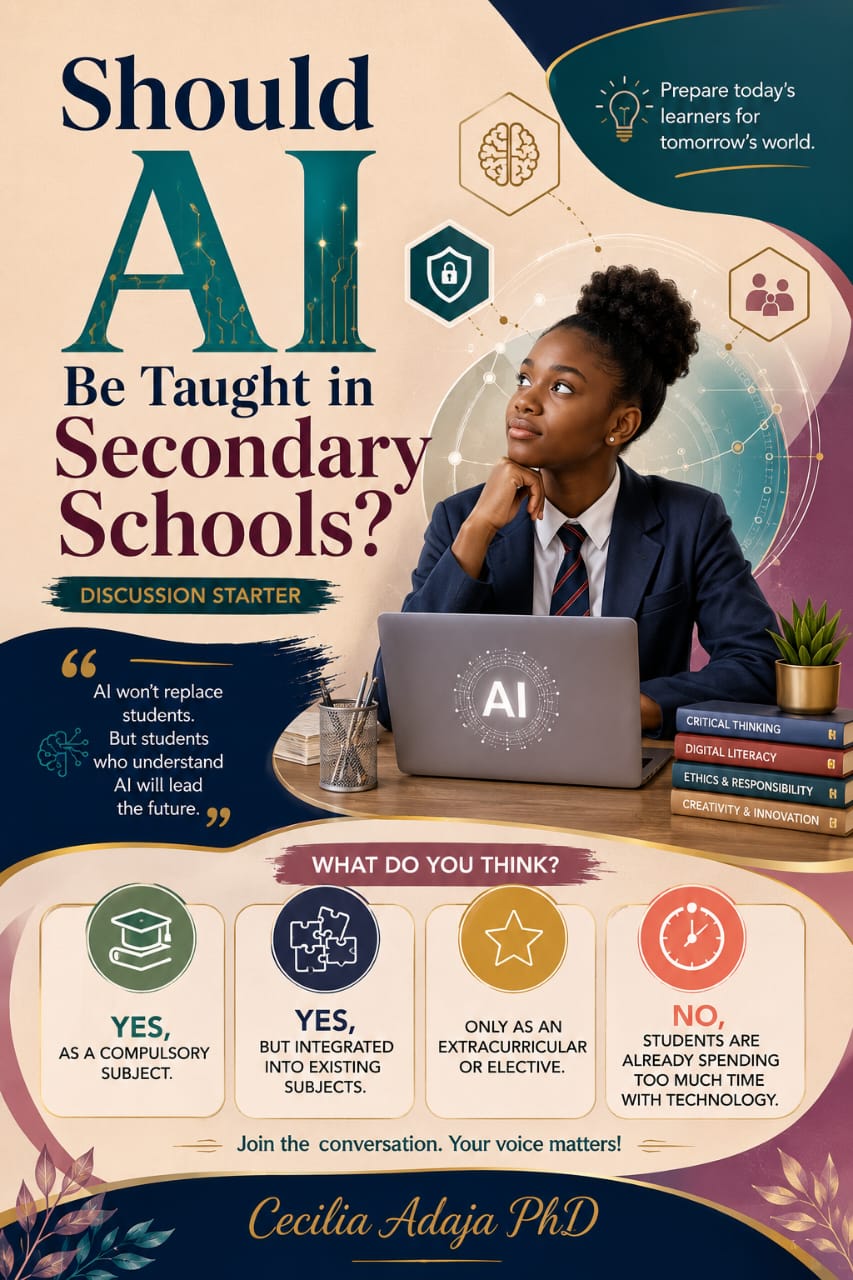
What do you think?
Should AI be taught in secondary schools?
🟢 Yes, as a compulsory subject.
🔵 Yes, but integrated into existing subjects.
🟡 Only as an extracurricular or elective.
🔴 No, students are already spending too much time with technology.
Cecilia Adaja (PhD)